Site identifier
HeyDonto FHIR R4 API - Administration (1.0)
The Administrative module covers the base data that is then linked into the other modules for clinical content, finance/billing, workflow, etc. It is built on the FHIR technology platform modules.
Before any clinical data can be recorded, the basic information of the patient must be recorded, and then often the basis of the interaction (such as an encounter).
Track people involved in receiving healthcare, the basics nearly everything else references back to:
- Patient - Demographics and other administrative information about an individual or animal receiving care or other health-related services
- RelatedPerson - Information about a person that is involved in the care for a patient, but who is not the target of healthcare, nor has a formal responsibility in the care process
- Person - Demographics and administrative information about a person independent of a specific health-related context
- Group - Represents a defined collection of entities that may be discussed or acted upon collectively but which are not expected to act collectively, and are not formally or legally recognized
Image showing the relationship between resources representing people:
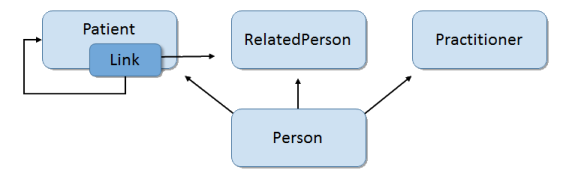
Implementation Note: Patient linking should also be considered when evaluating searches with references to other resources. e.g. searching for a patients' conditions for a patient. At present the specification does not define if the links should be also followed to include conditions that reference the linked patients too. We are currently seeking feedback on this.
Implementation Note: The Person resource may be used as a centralized register of people that may eventually be involved in healthcare, and could be used as the central core demographics register. However, the fields/values in Person are duplicated in the other resources, and in many cases the Person resource will be hosted on external systems.
Most clinical activities occur grouped in some way. Long term care is typically covered by an EpisodeOfCare, whereas short term care is covered by encounters. Account associates the tracking of transactions back to a Patient (or other resource). Flag is just used to highlight a warning or other notification about a patient (or other resource):
- EpisodeOfCare - An association between a patient and an organization / healthcare provider(s) during which time encounters may occur. The managing organization assumes a level of responsibility for the patient during this time
- Encounter - An interaction between a patient and healthcare provider(s) for the purpose of providing healthcare service(s) or assessing the health status of a patient
- Account - A financial tool for tracking value accrued for a particular purpose. In the healthcare field, used to track charges for a patient, cost centers, etc.
- Flag - Prospective warnings of potential issues when providing care to the patient
Image showing the administration interactions:
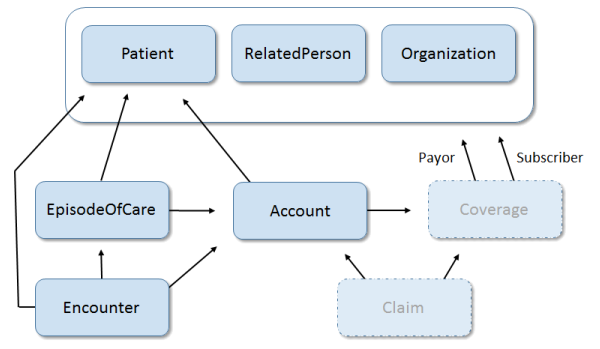
Implementation Note: Resources shown with a dotted box are described in other sections of the specification: Coverage and Claim are from the section on Finance.
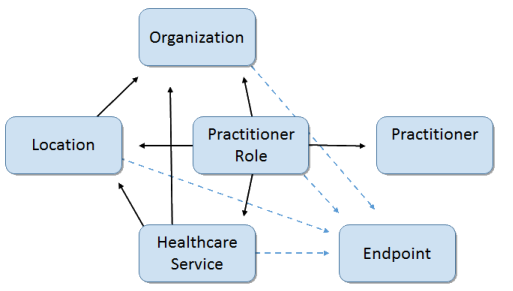
Service Provider Directory resources are usually stored in the administration section of applications, and may even be synchronized from external systems:
- Organization - A formally or informally recognized grouping of people or organizations formed for the purpose of achieving some form of collective action. Includes companies, institutions, corporations, departments, community groups, healthcare practice groups, payer/insurer, etc.
- Location - Details and position information for a physical place where services are provided and resources and participants may be stored, found, contained, or accommodated
- Practitioner - A person who is directly or indirectly involved in the provisioning of healthcare
- PractitionerRole - A specific set of Roles/Locations/specialties/services that a practitioner may perform at an organization for a period of time
- HealthcareService - The details of a healthcare service available at a location
- Endpoint - The technical details of an endpoint that can be used for electronic services, such as for web services providing XDS.b or a REST endpoint for another FHIR server. This may include any security context information
Image showing the provider directory resources:
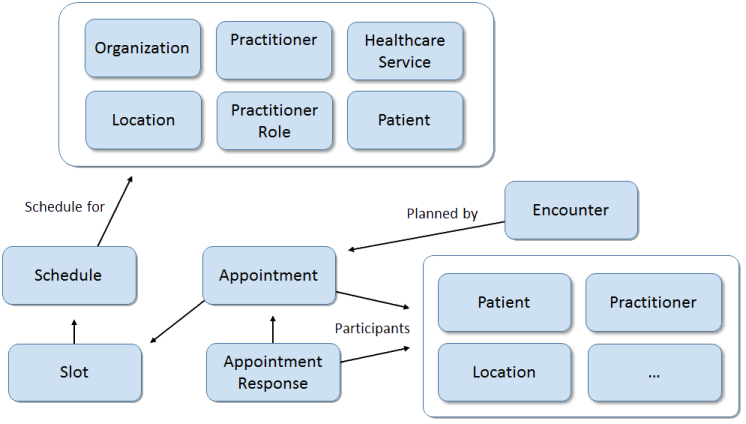
The Scheduling/Appointment resources permit the planning of encounters to occur and follow on with other clinical activities:
- Schedule - A container for slots of time that may be available for booking appointments
- Slot - A slot of time on a schedule that may be available for booking appointments
- Appointment - A booking of a healthcare event among patient(s), practitioner(s), related person(s) and/or device(s) for a specific date/time. This may result in one or more Encounter(s)
- AppointmentResponse - A reply to an appointment request for a patient and/or practitioner(s), such as a confirmation or rejection
Image showing the scheduling interactions:
Other assets are often registered in the administration system, and maintained as master files:
- Device - A type of a manufactured item that is used in the provision of healthcare without being substantially changed through that activity. The device may be a medical or non-medical device
- DeviceDefinition - The characteristics, operational status and capabilities of a medical-related component of a medical device
- DeviceMetric - Describes a measurement, calculation or setting capability of a medical device
- Substance - A homogeneous material with a definite composition
Patient privacy is handled with security labels and tags in the Resource Meta property. This is the standard way in which that the FHIR specification provides this supporting information to a sub-system that implements it (which is not defined by FHIR).
One of the more common use cases is for marking a patient as being a celebrity.
Note that privacy considerations apply to Person, Practitioner and RelatedPerson records in addition to Patient's.
While Organization, Location, Device and other non-person-identifying records are generally subject to less stringent security precautions, such data must still be protected to avoid safety issues (e.g. someone maliciously changing the ingredients associated with a drug to cause/fail to cause alerts).
Devices can be linked to Patients. If this occurs, they must be protected as any other patient-linked element.
For more general considerations, see the Security and Privacy module.
Administration Resources are cornerstone resources that are used by clinical and other domains of the FHIR Standard:
Managing a Master Record of a Patient and a Person (e.g. MPI) - A Patient resource is used to describe patient demographic information and any updates to it. It can be used to communicate Patient information to other systems (e.g. other registries, clinical, ancillary and financial systems). Some systems distinguish the Patient Registry (or Client Registry) from the Person Registry. A Person resource is a base for the Person Registry system. The Patient/Person Management use case includes creation, update, as well as merge/unmerge and link/unlink scenarios.
Managing a Master Record of a Provider and Service Catalogue (e.g. Provider Registry, Service Directory) - A Practitioner resource is a base resource for enabling the registry of individuals, related to providing health care services. Other resources, such as Organization, Location, HealthcareService, are creating a complete picture of where, how and by whom the care services are offered to a patient. The resources can be used for managing the master record or as a reference in clinical resources to inform about participants and places for various clinical resources.
Managing Other Administrative Records - The Administration domain of the FHIR standard includes creation and update of Device and Substance records. Resources can be used for managing a master record or communicating its information to other systems.
Enabling Patient Profiles, Clinical Reporting and Connecting Clinical Records - Administration Resources are referred to by almost all clinical resources. Querying systems, using the references to Administration Resources enables the creation of profiles and reports of various complexities.
Enabling Clinical Grouping and Financial Reporting - Other use cases are included in the roadmap of resources, developed by the Patient Administration group. The roadmap section lists plans and updates of the current work.
The Patient Administration is currently working through resources that support:
- Encounters and Scheduling (enhance maturity of encounters and further develop in/outpatient scheduling)
- Service Provider Directory (in co-ordination with the Argonaut Provider Directory group)
- Financial Management interactions (account/coverage, then charge item, which links administration to billing)
Many of the administrative resources are part of the core resources that most systems use first and have formed the basis for most people's first experiences with FHIR. However this limited exposure has still to be proven in all contexts, such as veterinary, public health and clinical research.
Overview
Languages
Servers
Mock server
https://docs.heydonto.com/_mock/apis/fhir/administration/
Sandbox
https://api-staging.heydonto.com/
Production
https://api.heydonto.com/
Query
Sort the results by a given field, e.g. _sort=family or _sort=-date.
Example: _sort=family
Restrict returned fields, e.g. _elements=identifier,name.
Example: _elements=identifier,name
Filter by resource telecom, e.g. date=[SYSTEM]|[VALUE].
Example: telecom=telecom=phone|555-555-5555
Search for resources by identifier token, e.g. identifier=http://hospital.org|12345.
Example: identifier=http://hospital.org|12345
Include related patient resources, e.g. patient=Patient/[id]&.
Example: patient=patient=Patient/[id]&
Reverse chaining, e.g. _has:Observation:subject:code=http://loinc.org|1234-5.
Example: _has=Observation:subject:code=http://loinc.org|1234-5
Search by tag on the resource meta, e.g. _tag=http://example.org/tags|sample-tag.
Example: _tag=http://example.org/tags|sample-tag
Search by security label on resource meta, e.g. _security=RBAC|CONFIDENTIAL.
Example: _security=RBAC|CONFIDENTIAL
- Mock server
https://docs.heydonto.com/_mock/apis/fhir/administration/site/{siteId}/fhir/group
- Sandbox
https://api-staging.heydonto.com/site/{siteId}/fhir/group
- Production
https://api.heydonto.com/site/{siteId}/fhir/group
- curl
- JavaScript
- Node.js
- Python
- Java
- C#
- PHP
- Go
- Ruby
- R
- Payload
curl -i -X GET \
  'https://docs.heydonto.com/_mock/apis/fhir/administration/site/{siteId}/fhir/group?_count=10&_page_token=CgYK...&_sort=family&_elements=identifier%2Cname&telecom=telecom%3Dphone%2C555-555-5555&_id=abc123&identifier=http%3A%2F%2Fhospital.org%2C12345&_include=string&patient=patient%3DPatient%2F%5Bid%5D%26&_revinclude=string&_has=Observation%3Asubject%3Acode%3Dhttp%3A%2F%2Floinc.org%2C1234-5&_tag=http%3A%2F%2Fexample.org%2Ftags%2Csample-tag&_security=RBAC%2CCONFIDENTIAL&_profile=http%3A%2F%2Fexample.org%2Ffhir%2FStructureDefinition%2Fcustom-profile' \
-H 'Authorization: Bearer <YOUR_JWT_HERE>'Bodyapplication/json
Any combination of letters, numerals, "-" and ".", with a length limit of 64 characters. (This might be an integer, an unprefixed OID, UUID or any other identifier pattern that meets these constraints.) Ids are case-insensitive.
Example: "example-id"
The metadata about a resource. This is content in the resource that is maintained by the infrastructure. Changes to the content might not always be associated with version changes to the resource.
String of characters used to identify a name or a resource
Example: "https://example.org/resource"
A string which has at least one character and no leading or trailing whitespace and where there is no whitespace other than single spaces in the contents
Example: "sample-code"
An identifier - identifies some entity uniquely and unambiguously. Typically this is used for business identifiers.
Indicates the purpose of this bundle - how it is intended to be used.
Enum"document""message""transaction""transaction-response""batch""batch-response""history""searchset""collection"
Example: "searchset"
An instant in time - known at least to the second
Example: "2024-01-01T00:00:00Z"
An integer with a value that is not negative (e.g. >= 0)
Example: 0
A series of links that provide context to this bundle.
Example: [{"relation":"search","url":"https://api.heydonto.com/fhir/group/?_count=20"},{"relation":"next","url":"https://api.heydonto.com/fhir/group/?_count=20&_page_token=TOKEN"},{"relation":"first","url":"https://api.heydonto.com/fhir/group/?_count=20"},{"relation":"self","url":"https://api.heydonto.com/fhir/group/?_count=20"}]
An entry in a bundle resource - will either contain a resource or information about a resource (transactions and history only).
Example: [{"resourceType":"Group","id":"101","text":{"status":"additional","div":"<div xmlns=\"http://www.w3.org/1999/xhtml\">\n <p>Herd of 25 horses</p>\n <p>Gender: mixed</p>\n <p>Owner: John Smith</p>\n </div>"},"identifier":[{"system":"http://someveterinarianclinic.org/fhir/NamingSystem/herds","value":"12345"}],"type":"animal","actual":true,"code":{"text":"Horse"},"name":"John's herd","quantity":25,"characteristic":[{"code":{"text":"gender"},"valueCodeableConcept":{"text":"mixed"},"exclude":false},{"code":{"text":"owner"},"valueCodeableConcept":{"text":"John Smith"},"exclude":false}]}]
A signature along with supporting context. The signature may be a digital signature that is cryptographic in nature, or some other signature acceptable to the domain. This other signature may be as simple as a graphical image representing a hand-written signature, or a signature ceremony Different signature approaches have different utilities.
Response
application/json
{
  "resourceType": "Bundle",
  "type": "searchset",
  "total": 100,
  "link": [
    { … },
    { … },
    { … },
    { … }
  ],
  "entry": [
    { … }
  ]
}
Bodyapplication/jsonrequired
Any combination of letters, numerals, "-" and ".", with a length limit of 64 characters. (This might be an integer, an unprefixed OID, UUID or any other identifier pattern that meets these constraints.) Ids are case-insensitive.
Example: "example-id"
The metadata about a resource. This is content in the resource that is maintained by the infrastructure. Changes to the content might not always be associated with version changes to the resource.
String of characters used to identify a name or a resource
Example: "https://example.org/resource"
A string which has at least one character and no leading or trailing whitespace and where there is no whitespace other than single spaces in the contents
Example: "sample-code"
A human-readable summary of the resource conveying the essential clinical and business information for the resource.
containedArray of #Account (object) or #ActivityDefinition (object) or #AdverseEvent (object) or #AllergyIntolerance (object) or #Appointment (object) or #AppointmentResponse (object) or #AuditEvent (object) or #Basic (object) or #Binary (object) or #BiologicallyDerivedProduct (object) or #BodyStructure (object) or #Bundle (object) or #CapabilityStatement (object) or #CarePlan (object) or #CareTeam (object) or #CatalogEntry (object) or #ChargeItem (object) or #ChargeItemDefinition (object) or #Claim (object) or #ClaimResponse (object) or #ClinicalImpression (object) or #CodeSystem (object) or #Communication (object) or #CommunicationRequest (object) or #CompartmentDefinition (object) or #Composition (object) or #ConceptMap (object) or #Condition (object) or #Consent (object) or #Contract (object) or #Coverage (object) or #CoverageEligibilityRequest (object) or #CoverageEligibilityResponse (object) or #DetectedIssue (object) or #Device (object) or #DeviceDefinition (object) or #DeviceMetric (object) or #DeviceRequest (object) or #DeviceUseStatement (object) or #DiagnosticReport (object) or #DocumentManifest (object) or #DocumentReference (object) or #EffectEvidenceSynthesis (object) or #Encounter (object) or #Endpoint (object) or #EnrollmentRequest (object) or #EnrollmentResponse (object) or #EpisodeOfCare (object) or #EventDefinition (object) or #Evidence (object) or #EvidenceVariable (object) or #ExampleScenario (object) or #ExplanationOfBenefit (object) or #FamilyMemberHistory (object) or #Flag (object) or #Goal (object) or #GraphDefinition (object) or #Group (object) or #GuidanceResponse (object) or #HealthcareService (object) or #ImagingStudy (object) or #Immunization (object) or #ImmunizationEvaluation (object) or #ImmunizationRecommendation (object) or #ImplementationGuide (object) or #InsurancePlan (object) or #Invoice (object) or #Library (object) or #Linkage (object) or #List (object) or #Location (object) or #Measure (object) or #MeasureReport (object) or #Media (object) or #Medication (object) or #MedicationAdministration (object) or #MedicationDispense (object) or #MedicationKnowledge (object) or #MedicationRequest (object) or #MedicationStatement (object) or #MedicinalProduct (object) or #MedicinalProductAuthorization (object) or #MedicinalProductContraindication (object) or #MedicinalProductIndication (object) or #MedicinalProductIngredient (object) or #MedicinalProductInteraction (object) or #MedicinalProductManufactured (object) or #MedicinalProductPackaged (object) or #MedicinalProductPharmaceutical (object) or #MedicinalProductUndesirableEffect (object) or #MessageDefinition (object) or #MessageHeader (object) or #MolecularSequence (object) or #NamingSystem (object) or #NutritionOrder (object) or #Observation (object) or #ObservationDefinition (object) or #OperationDefinition (object) or #OperationOutcome (object) or #Organization (object) or #OrganizationAffiliation (object) or #Parameters (object) or #Patient (object) or #PaymentNotice (object) or #PaymentReconciliation (object) or #Person (object) or #PlanDefinition (object) or #Practitioner (object) or #PractitionerRole (object) or #Procedure (object) or #Provenance (object) or #Questionnaire (object) or #QuestionnaireResponse (object) or #RelatedPerson (object) or #RequestGroup (object) or #ResearchDefinition (object) or #ResearchElementDefinition (object) or #ResearchStudy (object) or #ResearchSubject (object) or #RiskAssessment (object) or #RiskEvidenceSynthesis (object) or #Schedule (object) or #SearchParameter (object) or #ServiceRequest (object) or #Slot (object) or #Specimen (object) or #SpecimenDefinition (object) or #StructureDefinition (object) or #StructureMap (object) or #Subscription (object) or #Substance (object) or #SubstanceNucleicAcid (object) or #SubstancePolymer (object) or #SubstanceProtein (object) or #SubstanceReferenceInformation (object) or #SubstanceSourceMaterial (object) or #SubstanceSpecification (object) or #SupplyDelivery (object) or #SupplyRequest (object) or #Task (object) or #TerminologyCapabilities (object) or #TestReport (object) or #TestScript (object) or #ValueSet (object) or #VerificationResult (object) or #VisionPrescription (object)(ResourceList)
These resources do not have an independent existence apart from the resource that contains them - they cannot be identified independently, and nor can they have their own independent transaction scope.
May be used to represent additional information that is not part of the basic definition of the resource. To make the use of extensions safe and manageable, there is a strict set of governance applied to the definition and use of extensions. Though any implementer can define an extension, there is a set of requirements that SHALL be met as part of the definition of the extension.
May be used to represent additional information that is not part of the basic definition of the resource and that modifies the understanding of the element that contains it and/or the understanding of the containing element's descendants. Usually modifier elements provide negation or qualification. To make the use of extensions safe and manageable, there is a strict set of governance applied to the definition and use of extensions. Though any implementer is allowed to define an extension, there is a set of requirements that SHALL be met as part of the definition of the extension. Applications processing a resource are required to check for modifier extensions.
Modifier extensions SHALL NOT change the meaning of any elements on Resource or DomainResource (including cannot change the meaning of modifierExtension itself).
A unique business identifier for this group.
Example: [{"system":"http://someveterinarianclinic.org/fhir/NamingSystem/herds","value":"12345"}]
Identifies the broad classification of the kind of resources the group includes.
Enum"person""animal""practitioner""device""medication""substance"
Example: "animal"
A concept that may be defined by a formal reference to a terminology or ontology or may be provided by text.
An integer with a value that is not negative (e.g. >= 0)
Example: 0
Identifies traits whose presence r absence is shared by members of the group.
Example: [{"code":{"text":"gender"},"valueCodeableConcept":{"text":"mixed"},"exclude":false},{"code":{"text":"owner"},"valueCodeableConcept":{"text":"John Smith"},"exclude":false}]
- Mock server
https://docs.heydonto.com/_mock/apis/fhir/administration/site/{siteId}/fhir/group
- Sandbox
https://api-staging.heydonto.com/site/{siteId}/fhir/group
- Production
https://api.heydonto.com/site/{siteId}/fhir/group
- curl
- JavaScript
- Node.js
- Python
- Java
- C#
- PHP
- Go
- Ruby
- R
- Payload
curl -i -X POST \
  'https://docs.heydonto.com/_mock/apis/fhir/administration/site/{siteId}/fhir/group' \
  -H 'Authorization: Bearer <YOUR_JWT_HERE>' \
  -H 'Content-Type: application/json' \
  -d '{
    "resourceType": "Group",
    "id": "101",
    "text": {
      "status": "additional",
      "div": "<div xmlns=\"http://www.w3.org/1999/xhtml\">\n      <p>Herd of 25 horses</p>\n      <p>Gender: mixed</p>\n      <p>Owner: John Smith</p>\n    </div>"
    },
    "identifier": [
      {
        "system": "http://someveterinarianclinic.org/fhir/NamingSystem/herds",
        "value": "12345"
      }
    ],
    "type": "animal",
    "actual": true,
    "code": {
      "text": "Horse"
    },
    "name": "John'\''s herd",
    "quantity": 25,
    "characteristic": [
      {
        "code": {
          "text": "gender"
        },
        "valueCodeableConcept": {
          "text": "mixed"
        },
        "exclude": false
      },
      {
        "code": {
          "text": "owner"
        },
        "valueCodeableConcept": {
          "text": "John Smith"
        },
        "exclude": false
      }
    ]
}'Bodyapplication/json
Any combination of letters, numerals, "-" and ".", with a length limit of 64 characters. (This might be an integer, an unprefixed OID, UUID or any other identifier pattern that meets these constraints.) Ids are case-insensitive.
Example: "example-id"
The metadata about a resource. This is content in the resource that is maintained by the infrastructure. Changes to the content might not always be associated with version changes to the resource.
String of characters used to identify a name or a resource
Example: "https://example.org/resource"
A string which has at least one character and no leading or trailing whitespace and where there is no whitespace other than single spaces in the contents
Example: "sample-code"
A human-readable summary of the resource conveying the essential clinical and business information for the resource.
containedArray of #Account (object) or #ActivityDefinition (object) or #AdverseEvent (object) or #AllergyIntolerance (object) or #Appointment (object) or #AppointmentResponse (object) or #AuditEvent (object) or #Basic (object) or #Binary (object) or #BiologicallyDerivedProduct (object) or #BodyStructure (object) or #Bundle (object) or #CapabilityStatement (object) or #CarePlan (object) or #CareTeam (object) or #CatalogEntry (object) or #ChargeItem (object) or #ChargeItemDefinition (object) or #Claim (object) or #ClaimResponse (object) or #ClinicalImpression (object) or #CodeSystem (object) or #Communication (object) or #CommunicationRequest (object) or #CompartmentDefinition (object) or #Composition (object) or #ConceptMap (object) or #Condition (object) or #Consent (object) or #Contract (object) or #Coverage (object) or #CoverageEligibilityRequest (object) or #CoverageEligibilityResponse (object) or #DetectedIssue (object) or #Device (object) or #DeviceDefinition (object) or #DeviceMetric (object) or #DeviceRequest (object) or #DeviceUseStatement (object) or #DiagnosticReport (object) or #DocumentManifest (object) or #DocumentReference (object) or #EffectEvidenceSynthesis (object) or #Encounter (object) or #Endpoint (object) or #EnrollmentRequest (object) or #EnrollmentResponse (object) or #EpisodeOfCare (object) or #EventDefinition (object) or #Evidence (object) or #EvidenceVariable (object) or #ExampleScenario (object) or #ExplanationOfBenefit (object) or #FamilyMemberHistory (object) or #Flag (object) or #Goal (object) or #GraphDefinition (object) or #Group (object) or #GuidanceResponse (object) or #HealthcareService (object) or #ImagingStudy (object) or #Immunization (object) or #ImmunizationEvaluation (object) or #ImmunizationRecommendation (object) or #ImplementationGuide (object) or #InsurancePlan (object) or #Invoice (object) or #Library (object) or #Linkage (object) or #List (object) or #Location (object) or #Measure (object) or #MeasureReport (object) or #Media (object) or #Medication (object) or #MedicationAdministration (object) or #MedicationDispense (object) or #MedicationKnowledge (object) or #MedicationRequest (object) or #MedicationStatement (object) or #MedicinalProduct (object) or #MedicinalProductAuthorization (object) or #MedicinalProductContraindication (object) or #MedicinalProductIndication (object) or #MedicinalProductIngredient (object) or #MedicinalProductInteraction (object) or #MedicinalProductManufactured (object) or #MedicinalProductPackaged (object) or #MedicinalProductPharmaceutical (object) or #MedicinalProductUndesirableEffect (object) or #MessageDefinition (object) or #MessageHeader (object) or #MolecularSequence (object) or #NamingSystem (object) or #NutritionOrder (object) or #Observation (object) or #ObservationDefinition (object) or #OperationDefinition (object) or #OperationOutcome (object) or #Organization (object) or #OrganizationAffiliation (object) or #Parameters (object) or #Patient (object) or #PaymentNotice (object) or #PaymentReconciliation (object) or #Person (object) or #PlanDefinition (object) or #Practitioner (object) or #PractitionerRole (object) or #Procedure (object) or #Provenance (object) or #Questionnaire (object) or #QuestionnaireResponse (object) or #RelatedPerson (object) or #RequestGroup (object) or #ResearchDefinition (object) or #ResearchElementDefinition (object) or #ResearchStudy (object) or #ResearchSubject (object) or #RiskAssessment (object) or #RiskEvidenceSynthesis (object) or #Schedule (object) or #SearchParameter (object) or #ServiceRequest (object) or #Slot (object) or #Specimen (object) or #SpecimenDefinition (object) or #StructureDefinition (object) or #StructureMap (object) or #Subscription (object) or #Substance (object) or #SubstanceNucleicAcid (object) or #SubstancePolymer (object) or #SubstanceProtein (object) or #SubstanceReferenceInformation (object) or #SubstanceSourceMaterial (object) or #SubstanceSpecification (object) or #SupplyDelivery (object) or #SupplyRequest (object) or #Task (object) or #TerminologyCapabilities (object) or #TestReport (object) or #TestScript (object) or #ValueSet (object) or #VerificationResult (object) or #VisionPrescription (object)(ResourceList)
These resources do not have an independent existence apart from the resource that contains them - they cannot be identified independently, and nor can they have their own independent transaction scope.
May be used to represent additional information that is not part of the basic definition of the resource. To make the use of extensions safe and manageable, there is a strict set of governance applied to the definition and use of extensions. Though any implementer can define an extension, there is a set of requirements that SHALL be met as part of the definition of the extension.
May be used to represent additional information that is not part of the basic definition of the resource and that modifies the understanding of the element that contains it and/or the understanding of the containing element's descendants. Usually modifier elements provide negation or qualification. To make the use of extensions safe and manageable, there is a strict set of governance applied to the definition and use of extensions. Though any implementer is allowed to define an extension, there is a set of requirements that SHALL be met as part of the definition of the extension. Applications processing a resource are required to check for modifier extensions.
Modifier extensions SHALL NOT change the meaning of any elements on Resource or DomainResource (including cannot change the meaning of modifierExtension itself).
A unique business identifier for this group.
Example: [{"system":"http://someveterinarianclinic.org/fhir/NamingSystem/herds","value":"12345"}]
Identifies the broad classification of the kind of resources the group includes.
Enum"person""animal""practitioner""device""medication""substance"
Example: "animal"
A concept that may be defined by a formal reference to a terminology or ontology or may be provided by text.
An integer with a value that is not negative (e.g. >= 0)
Example: 0
Identifies traits whose presence r absence is shared by members of the group.
Example: [{"code":{"text":"gender"},"valueCodeableConcept":{"text":"mixed"},"exclude":false},{"code":{"text":"owner"},"valueCodeableConcept":{"text":"John Smith"},"exclude":false}]
Response
application/json
{
  "resourceType": "Group",
  "id": "101",
  "text": {
    "status": "additional",
    "div": "<div xmlns=\"http://www.w3.org/1999/xhtml\">\n      <p>Herd of 25 horses</p>\n      <p>Gender: mixed</p>\n      <p>Owner: John Smith</p>\n    </div>"
  },
  "identifier": [
    { … }
  ],
  "type": "animal",
  "actual": true,
  "code": {
    "text": "Horse"
  },
  "name": "John's herd",
  "quantity": 25,
  "characteristic": [
    { … },
    { … }
  ]
}
- Mock server
https://docs.heydonto.com/_mock/apis/fhir/administration/site/{siteId}/fhir/group/{id}
- Sandbox
https://api-staging.heydonto.com/site/{siteId}/fhir/group/{id}
- Production
https://api.heydonto.com/site/{siteId}/fhir/group/{id}
- curl
- JavaScript
- Node.js
- Python
- Java
- C#
- PHP
- Go
- Ruby
- R
- Payload
curl -i -X GET \
  'https://docs.heydonto.com/_mock/apis/fhir/administration/site/{siteId}/fhir/group/{id}' \
-H 'Authorization: Bearer <YOUR_JWT_HERE>'Bodyapplication/json
Any combination of letters, numerals, "-" and ".", with a length limit of 64 characters. (This might be an integer, an unprefixed OID, UUID or any other identifier pattern that meets these constraints.) Ids are case-insensitive.
Example: "example-id"
The metadata about a resource. This is content in the resource that is maintained by the infrastructure. Changes to the content might not always be associated with version changes to the resource.
String of characters used to identify a name or a resource
Example: "https://example.org/resource"
A string which has at least one character and no leading or trailing whitespace and where there is no whitespace other than single spaces in the contents
Example: "sample-code"
A human-readable summary of the resource conveying the essential clinical and business information for the resource.
containedArray of #Account (object) or #ActivityDefinition (object) or #AdverseEvent (object) or #AllergyIntolerance (object) or #Appointment (object) or #AppointmentResponse (object) or #AuditEvent (object) or #Basic (object) or #Binary (object) or #BiologicallyDerivedProduct (object) or #BodyStructure (object) or #Bundle (object) or #CapabilityStatement (object) or #CarePlan (object) or #CareTeam (object) or #CatalogEntry (object) or #ChargeItem (object) or #ChargeItemDefinition (object) or #Claim (object) or #ClaimResponse (object) or #ClinicalImpression (object) or #CodeSystem (object) or #Communication (object) or #CommunicationRequest (object) or #CompartmentDefinition (object) or #Composition (object) or #ConceptMap (object) or #Condition (object) or #Consent (object) or #Contract (object) or #Coverage (object) or #CoverageEligibilityRequest (object) or #CoverageEligibilityResponse (object) or #DetectedIssue (object) or #Device (object) or #DeviceDefinition (object) or #DeviceMetric (object) or #DeviceRequest (object) or #DeviceUseStatement (object) or #DiagnosticReport (object) or #DocumentManifest (object) or #DocumentReference (object) or #EffectEvidenceSynthesis (object) or #Encounter (object) or #Endpoint (object) or #EnrollmentRequest (object) or #EnrollmentResponse (object) or #EpisodeOfCare (object) or #EventDefinition (object) or #Evidence (object) or #EvidenceVariable (object) or #ExampleScenario (object) or #ExplanationOfBenefit (object) or #FamilyMemberHistory (object) or #Flag (object) or #Goal (object) or #GraphDefinition (object) or #Group (object) or #GuidanceResponse (object) or #HealthcareService (object) or #ImagingStudy (object) or #Immunization (object) or #ImmunizationEvaluation (object) or #ImmunizationRecommendation (object) or #ImplementationGuide (object) or #InsurancePlan (object) or #Invoice (object) or #Library (object) or #Linkage (object) or #List (object) or #Location (object) or #Measure (object) or #MeasureReport (object) or #Media (object) or #Medication (object) or #MedicationAdministration (object) or #MedicationDispense (object) or #MedicationKnowledge (object) or #MedicationRequest (object) or #MedicationStatement (object) or #MedicinalProduct (object) or #MedicinalProductAuthorization (object) or #MedicinalProductContraindication (object) or #MedicinalProductIndication (object) or #MedicinalProductIngredient (object) or #MedicinalProductInteraction (object) or #MedicinalProductManufactured (object) or #MedicinalProductPackaged (object) or #MedicinalProductPharmaceutical (object) or #MedicinalProductUndesirableEffect (object) or #MessageDefinition (object) or #MessageHeader (object) or #MolecularSequence (object) or #NamingSystem (object) or #NutritionOrder (object) or #Observation (object) or #ObservationDefinition (object) or #OperationDefinition (object) or #OperationOutcome (object) or #Organization (object) or #OrganizationAffiliation (object) or #Parameters (object) or #Patient (object) or #PaymentNotice (object) or #PaymentReconciliation (object) or #Person (object) or #PlanDefinition (object) or #Practitioner (object) or #PractitionerRole (object) or #Procedure (object) or #Provenance (object) or #Questionnaire (object) or #QuestionnaireResponse (object) or #RelatedPerson (object) or #RequestGroup (object) or #ResearchDefinition (object) or #ResearchElementDefinition (object) or #ResearchStudy (object) or #ResearchSubject (object) or #RiskAssessment (object) or #RiskEvidenceSynthesis (object) or #Schedule (object) or #SearchParameter (object) or #ServiceRequest (object) or #Slot (object) or #Specimen (object) or #SpecimenDefinition (object) or #StructureDefinition (object) or #StructureMap (object) or #Subscription (object) or #Substance (object) or #SubstanceNucleicAcid (object) or #SubstancePolymer (object) or #SubstanceProtein (object) or #SubstanceReferenceInformation (object) or #SubstanceSourceMaterial (object) or #SubstanceSpecification (object) or #SupplyDelivery (object) or #SupplyRequest (object) or #Task (object) or #TerminologyCapabilities (object) or #TestReport (object) or #TestScript (object) or #ValueSet (object) or #VerificationResult (object) or #VisionPrescription (object)(ResourceList)
These resources do not have an independent existence apart from the resource that contains them - they cannot be identified independently, and nor can they have their own independent transaction scope.
May be used to represent additional information that is not part of the basic definition of the resource. To make the use of extensions safe and manageable, there is a strict set of governance applied to the definition and use of extensions. Though any implementer can define an extension, there is a set of requirements that SHALL be met as part of the definition of the extension.
May be used to represent additional information that is not part of the basic definition of the resource and that modifies the understanding of the element that contains it and/or the understanding of the containing element's descendants. Usually modifier elements provide negation or qualification. To make the use of extensions safe and manageable, there is a strict set of governance applied to the definition and use of extensions. Though any implementer is allowed to define an extension, there is a set of requirements that SHALL be met as part of the definition of the extension. Applications processing a resource are required to check for modifier extensions.
Modifier extensions SHALL NOT change the meaning of any elements on Resource or DomainResource (including cannot change the meaning of modifierExtension itself).
A unique business identifier for this group.
Example: [{"system":"http://someveterinarianclinic.org/fhir/NamingSystem/herds","value":"12345"}]
Identifies the broad classification of the kind of resources the group includes.
Enum"person""animal""practitioner""device""medication""substance"
Example: "animal"
A concept that may be defined by a formal reference to a terminology or ontology or may be provided by text.
An integer with a value that is not negative (e.g. >= 0)
Example: 0
Identifies traits whose presence r absence is shared by members of the group.
Example: [{"code":{"text":"gender"},"valueCodeableConcept":{"text":"mixed"},"exclude":false},{"code":{"text":"owner"},"valueCodeableConcept":{"text":"John Smith"},"exclude":false}]
Response
application/json
{
  "resourceType": "Group",
  "id": "101",
  "text": {
    "status": "additional",
    "div": "<div xmlns=\"http://www.w3.org/1999/xhtml\">\n      <p>Herd of 25 horses</p>\n      <p>Gender: mixed</p>\n      <p>Owner: John Smith</p>\n    </div>"
  },
  "identifier": [
    { … }
  ],
  "type": "animal",
  "actual": true,
  "code": {
    "text": "Horse"
  },
  "name": "John's herd",
  "quantity": 25,
  "characteristic": [
    { … },
    { … }
  ]
}
Bodyapplication/jsonrequired
Any combination of letters, numerals, "-" and ".", with a length limit of 64 characters. (This might be an integer, an unprefixed OID, UUID or any other identifier pattern that meets these constraints.) Ids are case-insensitive.
Example: "example-id"
The metadata about a resource. This is content in the resource that is maintained by the infrastructure. Changes to the content might not always be associated with version changes to the resource.
String of characters used to identify a name or a resource
Example: "https://example.org/resource"
A string which has at least one character and no leading or trailing whitespace and where there is no whitespace other than single spaces in the contents
Example: "sample-code"
A human-readable summary of the resource conveying the essential clinical and business information for the resource.
containedArray of #Account (object) or #ActivityDefinition (object) or #AdverseEvent (object) or #AllergyIntolerance (object) or #Appointment (object) or #AppointmentResponse (object) or #AuditEvent (object) or #Basic (object) or #Binary (object) or #BiologicallyDerivedProduct (object) or #BodyStructure (object) or #Bundle (object) or #CapabilityStatement (object) or #CarePlan (object) or #CareTeam (object) or #CatalogEntry (object) or #ChargeItem (object) or #ChargeItemDefinition (object) or #Claim (object) or #ClaimResponse (object) or #ClinicalImpression (object) or #CodeSystem (object) or #Communication (object) or #CommunicationRequest (object) or #CompartmentDefinition (object) or #Composition (object) or #ConceptMap (object) or #Condition (object) or #Consent (object) or #Contract (object) or #Coverage (object) or #CoverageEligibilityRequest (object) or #CoverageEligibilityResponse (object) or #DetectedIssue (object) or #Device (object) or #DeviceDefinition (object) or #DeviceMetric (object) or #DeviceRequest (object) or #DeviceUseStatement (object) or #DiagnosticReport (object) or #DocumentManifest (object) or #DocumentReference (object) or #EffectEvidenceSynthesis (object) or #Encounter (object) or #Endpoint (object) or #EnrollmentRequest (object) or #EnrollmentResponse (object) or #EpisodeOfCare (object) or #EventDefinition (object) or #Evidence (object) or #EvidenceVariable (object) or #ExampleScenario (object) or #ExplanationOfBenefit (object) or #FamilyMemberHistory (object) or #Flag (object) or #Goal (object) or #GraphDefinition (object) or #Group (object) or #GuidanceResponse (object) or #HealthcareService (object) or #ImagingStudy (object) or #Immunization (object) or #ImmunizationEvaluation (object) or #ImmunizationRecommendation (object) or #ImplementationGuide (object) or #InsurancePlan (object) or #Invoice (object) or #Library (object) or #Linkage (object) or #List (object) or #Location (object) or #Measure (object) or #MeasureReport (object) or #Media (object) or #Medication (object) or #MedicationAdministration (object) or #MedicationDispense (object) or #MedicationKnowledge (object) or #MedicationRequest (object) or #MedicationStatement (object) or #MedicinalProduct (object) or #MedicinalProductAuthorization (object) or #MedicinalProductContraindication (object) or #MedicinalProductIndication (object) or #MedicinalProductIngredient (object) or #MedicinalProductInteraction (object) or #MedicinalProductManufactured (object) or #MedicinalProductPackaged (object) or #MedicinalProductPharmaceutical (object) or #MedicinalProductUndesirableEffect (object) or #MessageDefinition (object) or #MessageHeader (object) or #MolecularSequence (object) or #NamingSystem (object) or #NutritionOrder (object) or #Observation (object) or #ObservationDefinition (object) or #OperationDefinition (object) or #OperationOutcome (object) or #Organization (object) or #OrganizationAffiliation (object) or #Parameters (object) or #Patient (object) or #PaymentNotice (object) or #PaymentReconciliation (object) or #Person (object) or #PlanDefinition (object) or #Practitioner (object) or #PractitionerRole (object) or #Procedure (object) or #Provenance (object) or #Questionnaire (object) or #QuestionnaireResponse (object) or #RelatedPerson (object) or #RequestGroup (object) or #ResearchDefinition (object) or #ResearchElementDefinition (object) or #ResearchStudy (object) or #ResearchSubject (object) or #RiskAssessment (object) or #RiskEvidenceSynthesis (object) or #Schedule (object) or #SearchParameter (object) or #ServiceRequest (object) or #Slot (object) or #Specimen (object) or #SpecimenDefinition (object) or #StructureDefinition (object) or #StructureMap (object) or #Subscription (object) or #Substance (object) or #SubstanceNucleicAcid (object) or #SubstancePolymer (object) or #SubstanceProtein (object) or #SubstanceReferenceInformation (object) or #SubstanceSourceMaterial (object) or #SubstanceSpecification (object) or #SupplyDelivery (object) or #SupplyRequest (object) or #Task (object) or #TerminologyCapabilities (object) or #TestReport (object) or #TestScript (object) or #ValueSet (object) or #VerificationResult (object) or #VisionPrescription (object)(ResourceList)
These resources do not have an independent existence apart from the resource that contains them - they cannot be identified independently, and nor can they have their own independent transaction scope.
May be used to represent additional information that is not part of the basic definition of the resource. To make the use of extensions safe and manageable, there is a strict set of governance applied to the definition and use of extensions. Though any implementer can define an extension, there is a set of requirements that SHALL be met as part of the definition of the extension.
May be used to represent additional information that is not part of the basic definition of the resource and that modifies the understanding of the element that contains it and/or the understanding of the containing element's descendants. Usually modifier elements provide negation or qualification. To make the use of extensions safe and manageable, there is a strict set of governance applied to the definition and use of extensions. Though any implementer is allowed to define an extension, there is a set of requirements that SHALL be met as part of the definition of the extension. Applications processing a resource are required to check for modifier extensions.
Modifier extensions SHALL NOT change the meaning of any elements on Resource or DomainResource (including cannot change the meaning of modifierExtension itself).
A unique business identifier for this group.
Example: [{"system":"http://someveterinarianclinic.org/fhir/NamingSystem/herds","value":"12345"}]
Identifies the broad classification of the kind of resources the group includes.
Enum"person""animal""practitioner""device""medication""substance"
Example: "animal"
A concept that may be defined by a formal reference to a terminology or ontology or may be provided by text.
An integer with a value that is not negative (e.g. >= 0)
Example: 0
Identifies traits whose presence r absence is shared by members of the group.
Example: [{"code":{"text":"gender"},"valueCodeableConcept":{"text":"mixed"},"exclude":false},{"code":{"text":"owner"},"valueCodeableConcept":{"text":"John Smith"},"exclude":false}]
- Mock server
https://docs.heydonto.com/_mock/apis/fhir/administration/site/{siteId}/fhir/group/{id}
- Sandbox
https://api-staging.heydonto.com/site/{siteId}/fhir/group/{id}
- Production
https://api.heydonto.com/site/{siteId}/fhir/group/{id}
- curl
- JavaScript
- Node.js
- Python
- Java
- C#
- PHP
- Go
- Ruby
- R
- Payload
curl -i -X PUT \
  'https://docs.heydonto.com/_mock/apis/fhir/administration/site/{siteId}/fhir/group/{id}' \
  -H 'Authorization: Bearer <YOUR_JWT_HERE>' \
  -H 'Content-Type: application/json' \
  -d '{
    "resourceType": "Group",
    "id": "101",
    "text": {
      "status": "additional",
      "div": "<div xmlns=\"http://www.w3.org/1999/xhtml\">\n      <p>Herd of 25 horses</p>\n      <p>Gender: mixed</p>\n      <p>Owner: John Smith</p>\n    </div>"
    },
    "identifier": [
      {
        "system": "http://someveterinarianclinic.org/fhir/NamingSystem/herds",
        "value": "12345"
      }
    ],
    "type": "animal",
    "actual": true,
    "code": {
      "text": "Horse"
    },
    "name": "John'\''s herd",
    "quantity": 25,
    "characteristic": [
      {
        "code": {
          "text": "gender"
        },
        "valueCodeableConcept": {
          "text": "mixed"
        },
        "exclude": false
      },
      {
        "code": {
          "text": "owner"
        },
        "valueCodeableConcept": {
          "text": "John Smith"
        },
        "exclude": false
      }
    ]
}'Bodyapplication/json
Any combination of letters, numerals, "-" and ".", with a length limit of 64 characters. (This might be an integer, an unprefixed OID, UUID or any other identifier pattern that meets these constraints.) Ids are case-insensitive.
Example: "example-id"
The metadata about a resource. This is content in the resource that is maintained by the infrastructure. Changes to the content might not always be associated with version changes to the resource.
String of characters used to identify a name or a resource
Example: "https://example.org/resource"
A string which has at least one character and no leading or trailing whitespace and where there is no whitespace other than single spaces in the contents
Example: "sample-code"
A human-readable summary of the resource conveying the essential clinical and business information for the resource.
containedArray of #Account (object) or #ActivityDefinition (object) or #AdverseEvent (object) or #AllergyIntolerance (object) or #Appointment (object) or #AppointmentResponse (object) or #AuditEvent (object) or #Basic (object) or #Binary (object) or #BiologicallyDerivedProduct (object) or #BodyStructure (object) or #Bundle (object) or #CapabilityStatement (object) or #CarePlan (object) or #CareTeam (object) or #CatalogEntry (object) or #ChargeItem (object) or #ChargeItemDefinition (object) or #Claim (object) or #ClaimResponse (object) or #ClinicalImpression (object) or #CodeSystem (object) or #Communication (object) or #CommunicationRequest (object) or #CompartmentDefinition (object) or #Composition (object) or #ConceptMap (object) or #Condition (object) or #Consent (object) or #Contract (object) or #Coverage (object) or #CoverageEligibilityRequest (object) or #CoverageEligibilityResponse (object) or #DetectedIssue (object) or #Device (object) or #DeviceDefinition (object) or #DeviceMetric (object) or #DeviceRequest (object) or #DeviceUseStatement (object) or #DiagnosticReport (object) or #DocumentManifest (object) or #DocumentReference (object) or #EffectEvidenceSynthesis (object) or #Encounter (object) or #Endpoint (object) or #EnrollmentRequest (object) or #EnrollmentResponse (object) or #EpisodeOfCare (object) or #EventDefinition (object) or #Evidence (object) or #EvidenceVariable (object) or #ExampleScenario (object) or #ExplanationOfBenefit (object) or #FamilyMemberHistory (object) or #Flag (object) or #Goal (object) or #GraphDefinition (object) or #Group (object) or #GuidanceResponse (object) or #HealthcareService (object) or #ImagingStudy (object) or #Immunization (object) or #ImmunizationEvaluation (object) or #ImmunizationRecommendation (object) or #ImplementationGuide (object) or #InsurancePlan (object) or #Invoice (object) or #Library (object) or #Linkage (object) or #List (object) or #Location (object) or #Measure (object) or #MeasureReport (object) or #Media (object) or #Medication (object) or #MedicationAdministration (object) or #MedicationDispense (object) or #MedicationKnowledge (object) or #MedicationRequest (object) or #MedicationStatement (object) or #MedicinalProduct (object) or #MedicinalProductAuthorization (object) or #MedicinalProductContraindication (object) or #MedicinalProductIndication (object) or #MedicinalProductIngredient (object) or #MedicinalProductInteraction (object) or #MedicinalProductManufactured (object) or #MedicinalProductPackaged (object) or #MedicinalProductPharmaceutical (object) or #MedicinalProductUndesirableEffect (object) or #MessageDefinition (object) or #MessageHeader (object) or #MolecularSequence (object) or #NamingSystem (object) or #NutritionOrder (object) or #Observation (object) or #ObservationDefinition (object) or #OperationDefinition (object) or #OperationOutcome (object) or #Organization (object) or #OrganizationAffiliation (object) or #Parameters (object) or #Patient (object) or #PaymentNotice (object) or #PaymentReconciliation (object) or #Person (object) or #PlanDefinition (object) or #Practitioner (object) or #PractitionerRole (object) or #Procedure (object) or #Provenance (object) or #Questionnaire (object) or #QuestionnaireResponse (object) or #RelatedPerson (object) or #RequestGroup (object) or #ResearchDefinition (object) or #ResearchElementDefinition (object) or #ResearchStudy (object) or #ResearchSubject (object) or #RiskAssessment (object) or #RiskEvidenceSynthesis (object) or #Schedule (object) or #SearchParameter (object) or #ServiceRequest (object) or #Slot (object) or #Specimen (object) or #SpecimenDefinition (object) or #StructureDefinition (object) or #StructureMap (object) or #Subscription (object) or #Substance (object) or #SubstanceNucleicAcid (object) or #SubstancePolymer (object) or #SubstanceProtein (object) or #SubstanceReferenceInformation (object) or #SubstanceSourceMaterial (object) or #SubstanceSpecification (object) or #SupplyDelivery (object) or #SupplyRequest (object) or #Task (object) or #TerminologyCapabilities (object) or #TestReport (object) or #TestScript (object) or #ValueSet (object) or #VerificationResult (object) or #VisionPrescription (object)(ResourceList)
These resources do not have an independent existence apart from the resource that contains them - they cannot be identified independently, and nor can they have their own independent transaction scope.
May be used to represent additional information that is not part of the basic definition of the resource. To make the use of extensions safe and manageable, there is a strict set of governance applied to the definition and use of extensions. Though any implementer can define an extension, there is a set of requirements that SHALL be met as part of the definition of the extension.
May be used to represent additional information that is not part of the basic definition of the resource and that modifies the understanding of the element that contains it and/or the understanding of the containing element's descendants. Usually modifier elements provide negation or qualification. To make the use of extensions safe and manageable, there is a strict set of governance applied to the definition and use of extensions. Though any implementer is allowed to define an extension, there is a set of requirements that SHALL be met as part of the definition of the extension. Applications processing a resource are required to check for modifier extensions.
Modifier extensions SHALL NOT change the meaning of any elements on Resource or DomainResource (including cannot change the meaning of modifierExtension itself).
A unique business identifier for this group.
Example: [{"system":"http://someveterinarianclinic.org/fhir/NamingSystem/herds","value":"12345"}]
Identifies the broad classification of the kind of resources the group includes.
Enum"person""animal""practitioner""device""medication""substance"
Example: "animal"
A concept that may be defined by a formal reference to a terminology or ontology or may be provided by text.
An integer with a value that is not negative (e.g. >= 0)
Example: 0
Identifies traits whose presence r absence is shared by members of the group.
Example: [{"code":{"text":"gender"},"valueCodeableConcept":{"text":"mixed"},"exclude":false},{"code":{"text":"owner"},"valueCodeableConcept":{"text":"John Smith"},"exclude":false}]
Response
application/json
{
  "resourceType": "Group",
  "id": "101",
  "text": {
    "status": "additional",
    "div": "<div xmlns=\"http://www.w3.org/1999/xhtml\">\n      <p>Herd of 25 horses</p>\n      <p>Gender: mixed</p>\n      <p>Owner: John Smith</p>\n    </div>"
  },
  "identifier": [
    { … }
  ],
  "type": "animal",
  "actual": true,
  "code": {
    "text": "Horse"
  },
  "name": "John's herd",
  "quantity": 25,
  "characteristic": [
    { … },
    { … }
  ]
}
- Mock server
https://docs.heydonto.com/_mock/apis/fhir/administration/site/{siteId}/fhir/group/{id}
- Sandbox
https://api-staging.heydonto.com/site/{siteId}/fhir/group/{id}
- Production
https://api.heydonto.com/site/{siteId}/fhir/group/{id}
- curl
- JavaScript
- Node.js
- Python
- Java
- C#
- PHP
- Go
- Ruby
- R
- Payload
curl -i -X DELETE \
  'https://docs.heydonto.com/_mock/apis/fhir/administration/site/{siteId}/fhir/group/{id}' \
-H 'Authorization: Bearer <YOUR_JWT_HERE>'Response
application/json
{
  "statusText": "OK",
  "status": 200
}
- Mock server
https://docs.heydonto.com/_mock/apis/fhir/administration/site/{siteId}/fhir/group/{id}/history
- Sandbox
https://api-staging.heydonto.com/site/{siteId}/fhir/group/{id}/history
- Production
https://api.heydonto.com/site/{siteId}/fhir/group/{id}/history
- curl
- JavaScript
- Node.js
- Python
- Java
- C#
- PHP
- Go
- Ruby
- R
- Payload
curl -i -X GET \
  'https://docs.heydonto.com/_mock/apis/fhir/administration/site/{siteId}/fhir/group/{id}/history' \
-H 'Authorization: Bearer <YOUR_JWT_HERE>'Response
application/json
{
  "resourceType": "Bundle",
  "type": "history",
  "entry": [
    { … }
  ],
  "total": 2
}