Site identifier
HeyDonto FHIR R4 API - Diagnostic (1.0)
The Diagnostics Module provides an overview and guide to the FHIR content that addresses ordering and reporting of clinical diagnostics including laboratory testing, imaging and genomics.
The Diagnostics module covers the following resources:
- Observation - Measurements and simple assertions made about a patient, device or other subject
- DiagnosticReport - The findings and interpretation of diagnostic tests performed on patients, groups of patients, devices, and locations, and/or specimens derived from these. The report includes clinical context such as requesting and provider information, and some mix of atomic results, images, textual and coded interpretations, and formatted representation of diagnostic reports
- ServiceRequest - A record of a request for service such as diagnostic investigations, treatments, or operations to be performed
- Media - A photo, video, or audio recording acquired or used in healthcare. The actual content may be inline or provided by direct reference
- ImagingStudy - Representation of the content produced in a DICOM imaging study. A study comprises a set of series, each of which includes a set of Service-Object Pair Instances (SOP Instances - images or other data) acquired or produced in a common context. A series is of only one modality (e.g. X-ray, CT, MR, ultrasound), but a study may have multiple series of different modalities
- MolecularSequence - Raw data describing a biological sequence
- Specimen - A sample to be used for analysis
- BodyStructure - Record details about an anatomical structure. This resource may be used when a coded concept does not provide the necessary detail needed for the use case
The diagnostic resources and their relationships are shown below. The arrows represent the direction of the references between resources (for example, DiagnosticReport references ServiceRequest). See the Workflow Module for information about the coordination of activities such as ordering and fulfilling of diagnostics.
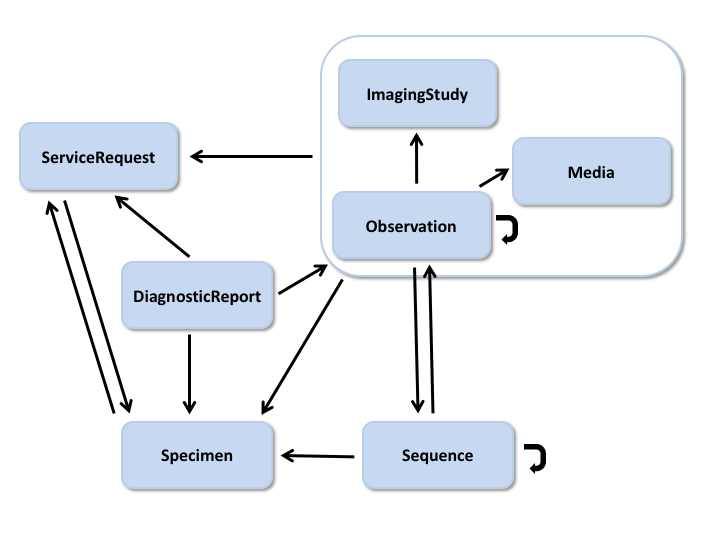
Implementation Note: See the Genomics Implementation Guidance for additional information about how to use the Diagnostic resources for Clinical Genomic Reporting and Analysis.
The diagnostic resources often represent patient-specific data, and as such are susceptible to data breaching. Necessary privacy and security provisions must be in place when searching and fetching this information. For more general considerations, see the Security and Privacy module.
Diagnostic resources are commonly used to plan, recommend, order and report clinical diagnostics:
- Planning a diagnostic test such as in this Careplan-example
- Recommending diagnostics such as is done by Clinical Decision Support tools. See the Clinical Reasoning module for more information
- Ordering a Laboratory Test such as a lipid panel
- Reporting a Laboratory Test such as a lipid panel
- Ordering an imaging study such as a CT study
- Reporting an imaging study such as a CT study
- Ordering a genetic test such as a gene mutation analysis
- Reporting a genetic test such as HLA genotyping
There are many ways to use these resources independently as well. The Observation resource, in particular, is central to capturing many measurements and events in healthcare and is often used outside the context of diagnostic orders and reports:
- Recording vital signs such as temperature
- Recording other observations of a patient's social history such as tobacco use
- Recording other characteristics of a patient such as pregnancy status (note: The Condition resource may be used to represent these as well)
- Recording clinical assessment tool scores such as an Apgar score
- Identifying and describing a specimen or body site
The Observation and Diagnostic Report resources have been tested and used in production tooling and as such have reached a maturity level FMM=4 where changes become less likely and require implementer community approval. Future work will focus on developing core profiles and clarifying use cases and boundaries and providing more domain specific examples. We anticipate Observation and Diagnostic Report reaching normative status by the end of this cycle.
The ImagingStudy resource has had some limited testing and use. Further use of this resource in production tooling is needed for it to reach a more stable FMM level.
The ServiceRequest resources has undergone substantial changes since DSTU2. Foremost of which is the merging of DSTU2 DiagnosticOrder and ServiceRequest into a single resource. In addition, as a result of the addition of FHIR workflow for STU3, its structure and content have been updated to align with the general FHIR workflow "request" pattern. Because of these, it remains a relatively immature resource. No more sweeping changes to its structure are expected. However, its scope and boundaries vis a vis other resources will be the topic of future workgroup efforts. We anticipate its broad use by implementers and that it will mature as a resource throughout the upcoming cycle.
The Specimen resource will be the focus of work group efforts for the upcoming cycle. A new SpecimenDefinition resource is planned for describing specimen types vs specimen instances and will take over some of the Specimen resource's current scope. We expect to see more widespread use of this resource and future updates to its FMM level.
The MolecularSequence resource remains draft and we expect to see more widespread use of this resource and future updates to its FMM level.
The BodyStructure resource is an immature resource with a FMM level of 1. To date there has been little implementation feedback.
The Media resource is the newest member to the Diagnostics module having undergone substantial scope and structural changes to create a specialized observation resource focused on digital media such as images and audio files. Future work will focus on developing core profiles and providing more domain specific examples.
Overview
Languages
Servers
Mock server
https://docs.heydonto.com/_mock/apis/fhir/diagnostic/
Sandbox
https://api-staging.heydonto.com/
Production
https://api.heydonto.com/
Query
Sort the results by a given field, e.g. _sort=family or _sort=-date.
Example: _sort=family
Restrict returned fields, e.g. _elements=identifier,name.
Example: _elements=identifier,name
Filter by resource telecom, e.g. date=[SYSTEM]|[VALUE].
Example: telecom=telecom=phone|555-555-5555
Search for resources by identifier token, e.g. identifier=http://hospital.org|12345.
Example: identifier=http://hospital.org|12345
Include related patient resources, e.g. patient=Patient/[id]&.
Example: patient=patient=Patient/[id]&
Reverse chaining, e.g. _has:Observation:subject:code=http://loinc.org|1234-5.
Example: _has=Observation:subject:code=http://loinc.org|1234-5
Search by tag on the resource meta, e.g. _tag=http://example.org/tags|sample-tag.
Example: _tag=http://example.org/tags|sample-tag
Search by security label on resource meta, e.g. _security=RBAC|CONFIDENTIAL.
Example: _security=RBAC|CONFIDENTIAL
- Mock server
https://docs.heydonto.com/_mock/apis/fhir/diagnostic/site/{siteId}/fhir/observation
- Sandbox
https://api-staging.heydonto.com/site/{siteId}/fhir/observation
- Production
https://api.heydonto.com/site/{siteId}/fhir/observation
- curl
- JavaScript
- Node.js
- Python
- Java
- C#
- PHP
- Go
- Ruby
- R
- Payload
curl -i -X GET \
  'https://docs.heydonto.com/_mock/apis/fhir/diagnostic/site/{siteId}/fhir/observation?_count=10&_page_token=CgYK...&_sort=family&_elements=identifier%2Cname&telecom=telecom%3Dphone%2C555-555-5555&_id=abc123&identifier=http%3A%2F%2Fhospital.org%2C12345&_include=string&patient=patient%3DPatient%2F%5Bid%5D%26&_revinclude=string&_has=Observation%3Asubject%3Acode%3Dhttp%3A%2F%2Floinc.org%2C1234-5&_tag=http%3A%2F%2Fexample.org%2Ftags%2Csample-tag&_security=RBAC%2CCONFIDENTIAL&_profile=http%3A%2F%2Fexample.org%2Ffhir%2FStructureDefinition%2Fcustom-profile' \
-H 'Authorization: Bearer <YOUR_JWT_HERE>'Bodyapplication/json
Any combination of letters, numerals, "-" and ".", with a length limit of 64 characters. (This might be an integer, an unprefixed OID, UUID or any other identifier pattern that meets these constraints.) Ids are case-insensitive.
Example: "example-id"
The metadata about a resource. This is content in the resource that is maintained by the infrastructure. Changes to the content might not always be associated with version changes to the resource.
String of characters used to identify a name or a resource
Example: "https://example.org/resource"
A string which has at least one character and no leading or trailing whitespace and where there is no whitespace other than single spaces in the contents
Example: "sample-code"
An identifier - identifies some entity uniquely and unambiguously. Typically this is used for business identifiers.
Indicates the purpose of this bundle - how it is intended to be used.
Enum"document""message""transaction""transaction-response""batch""batch-response""history""searchset""collection"
Example: "searchset"
An instant in time - known at least to the second
Example: "2024-01-01T00:00:00Z"
An integer with a value that is not negative (e.g. >= 0)
Example: 0
A series of links that provide context to this bundle.
Example: [{"relation":"search","url":"https://api.heydonto.com/fhir/observation/?_count=20"},{"relation":"next","url":"https://api.heydonto.com/fhir/observation/?_count=20&_page_token=TOKEN"},{"relation":"first","url":"https://api.heydonto.com/fhir/observation/?_count=20"},{"relation":"self","url":"https://api.heydonto.com/fhir/observation/?_count=20"}]
An entry in a bundle resource - will either contain a resource or information about a resource (transactions and history only).
Example: [{"resourceType":"Observation","id":"example","text":{"status":"generated","div":"<div xmlns=\"http://www.w3.org/1999/xhtml\"><p><b>Generated Narrative with Details</b></p><p><b>id</b>: example</p><p><b>status</b>: final</p><p><b>category</b>: Vital Signs <span>(Details : {http://terminology.hl7.org/CodeSystem/observation-category code 'vital-signs' = 'Vital Signs', given as 'Vital Signs'})</span></p><p><b>code</b>: Body Weight <span>(Details : {LOINC code '29463-7' = 'Body weight', given as 'Body Weight'}; {LOINC code '3141-9' = 'Body weight Measured', given as 'Body weight Measured'}; {SNOMED CT code '27113001' = 'Body weight', given as 'Body weight'}; {http://acme.org/devices/clinical-codes code 'body-weight' = 'body-weight', given as 'Body Weight'})</span></p><p><b>subject</b>: <a>Patient/example</a></p><p><b>encounter</b>: <a>Encounter/example</a></p><p><b>effective</b>: 28/03/2016</p><p><b>value</b>: 185 lbs<span> (Details: UCUM code [lb_av] = 'lb_av')</span></p></div>"},"status":"final","category":[{"coding":[{"system":"http://terminology.hl7.org/CodeSystem/observation-category","code":"vital-signs","display":"Vital Signs"}]}],"code":{"coding":[{"system":"http://loinc.org","code":"29463-7","display":"Body Weight"},{"system":"http://loinc.org","code":"3141-9","display":"Body weight Measured"},{"system":"http://snomed.info/sct","code":"27113001","display":"Body weight"},{"system":"http://acme.org/devices/clinical-codes","code":"body-weight","display":"Body Weight"}]},"subject":{"reference":"Patient/example"},"encounter":{"reference":"Encounter/example"},"effectiveDateTime":"2016-03-28","valueQuantity":{"value":185,"unit":"lbs","system":"http://unitsofmeasure.org","code":"[lb_av]"}}]
A signature along with supporting context. The signature may be a digital signature that is cryptographic in nature, or some other signature acceptable to the domain. This other signature may be as simple as a graphical image representing a hand-written signature, or a signature ceremony Different signature approaches have different utilities.
Response
application/json
{
  "resourceType": "Bundle",
  "type": "searchset",
  "total": 100,
  "link": [
    { … },
    { … },
    { … },
    { … }
  ],
  "entry": [
    { … }
  ]
}
Bodyapplication/jsonrequired
Any combination of letters, numerals, "-" and ".", with a length limit of 64 characters. (This might be an integer, an unprefixed OID, UUID or any other identifier pattern that meets these constraints.) Ids are case-insensitive.
Example: "example-id"
The metadata about a resource. This is content in the resource that is maintained by the infrastructure. Changes to the content might not always be associated with version changes to the resource.
String of characters used to identify a name or a resource
Example: "https://example.org/resource"
A string which has at least one character and no leading or trailing whitespace and where there is no whitespace other than single spaces in the contents
Example: "sample-code"
A human-readable summary of the resource conveying the essential clinical and business information for the resource.
containedArray of #Account (object) or #ActivityDefinition (object) or #AdverseEvent (object) or #AllergyIntolerance (object) or #Appointment (object) or #AppointmentResponse (object) or #AuditEvent (object) or #Basic (object) or #Binary (object) or #BiologicallyDerivedProduct (object) or #BodyStructure (object) or #Bundle (object) or #CapabilityStatement (object) or #CarePlan (object) or #CareTeam (object) or #CatalogEntry (object) or #ChargeItem (object) or #ChargeItemDefinition (object) or #Claim (object) or #ClaimResponse (object) or #ClinicalImpression (object) or #CodeSystem (object) or #Communication (object) or #CommunicationRequest (object) or #CompartmentDefinition (object) or #Composition (object) or #ConceptMap (object) or #Condition (object) or #Consent (object) or #Contract (object) or #Coverage (object) or #CoverageEligibilityRequest (object) or #CoverageEligibilityResponse (object) or #DetectedIssue (object) or #Device (object) or #DeviceDefinition (object) or #DeviceMetric (object) or #DeviceRequest (object) or #DeviceUseStatement (object) or #DiagnosticReport (object) or #DocumentManifest (object) or #DocumentReference (object) or #EffectEvidenceSynthesis (object) or #Encounter (object) or #Endpoint (object) or #EnrollmentRequest (object) or #EnrollmentResponse (object) or #EpisodeOfCare (object) or #EventDefinition (object) or #Evidence (object) or #EvidenceVariable (object) or #ExampleScenario (object) or #ExplanationOfBenefit (object) or #FamilyMemberHistory (object) or #Flag (object) or #Goal (object) or #GraphDefinition (object) or #Group (object) or #GuidanceResponse (object) or #HealthcareService (object) or #ImagingStudy (object) or #Immunization (object) or #ImmunizationEvaluation (object) or #ImmunizationRecommendation (object) or #ImplementationGuide (object) or #InsurancePlan (object) or #Invoice (object) or #Library (object) or #Linkage (object) or #List (object) or #Location (object) or #Measure (object) or #MeasureReport (object) or #Media (object) or #Medication (object) or #MedicationAdministration (object) or #MedicationDispense (object) or #MedicationKnowledge (object) or #MedicationRequest (object) or #MedicationStatement (object) or #MedicinalProduct (object) or #MedicinalProductAuthorization (object) or #MedicinalProductContraindication (object) or #MedicinalProductIndication (object) or #MedicinalProductIngredient (object) or #MedicinalProductInteraction (object) or #MedicinalProductManufactured (object) or #MedicinalProductPackaged (object) or #MedicinalProductPharmaceutical (object) or #MedicinalProductUndesirableEffect (object) or #MessageDefinition (object) or #MessageHeader (object) or #MolecularSequence (object) or #NamingSystem (object) or #NutritionOrder (object) or #Observation (object) or #ObservationDefinition (object) or #OperationDefinition (object) or #OperationOutcome (object) or #Organization (object) or #OrganizationAffiliation (object) or #Parameters (object) or #Patient (object) or #PaymentNotice (object) or #PaymentReconciliation (object) or #Person (object) or #PlanDefinition (object) or #Practitioner (object) or #PractitionerRole (object) or #Procedure (object) or #Provenance (object) or #Questionnaire (object) or #QuestionnaireResponse (object) or #RelatedPerson (object) or #RequestGroup (object) or #ResearchDefinition (object) or #ResearchElementDefinition (object) or #ResearchStudy (object) or #ResearchSubject (object) or #RiskAssessment (object) or #RiskEvidenceSynthesis (object) or #Schedule (object) or #SearchParameter (object) or #ServiceRequest (object) or #Slot (object) or #Specimen (object) or #SpecimenDefinition (object) or #StructureDefinition (object) or #StructureMap (object) or #Subscription (object) or #Substance (object) or #SubstanceNucleicAcid (object) or #SubstancePolymer (object) or #SubstanceProtein (object) or #SubstanceReferenceInformation (object) or #SubstanceSourceMaterial (object) or #SubstanceSpecification (object) or #SupplyDelivery (object) or #SupplyRequest (object) or #Task (object) or #TerminologyCapabilities (object) or #TestReport (object) or #TestScript (object) or #ValueSet (object) or #VerificationResult (object) or #VisionPrescription (object)(ResourceList)
These resources do not have an independent existence apart from the resource that contains them - they cannot be identified independently, and nor can they have their own independent transaction scope.
May be used to represent additional information that is not part of the basic definition of the resource. To make the use of extensions safe and manageable, there is a strict set of governance applied to the definition and use of extensions. Though any implementer can define an extension, there is a set of requirements that SHALL be met as part of the definition of the extension.
May be used to represent additional information that is not part of the basic definition of the resource and that modifies the understanding of the element that contains it and/or the understanding of the containing element's descendants. Usually modifier elements provide negation or qualification. To make the use of extensions safe and manageable, there is a strict set of governance applied to the definition and use of extensions. Though any implementer is allowed to define an extension, there is a set of requirements that SHALL be met as part of the definition of the extension. Applications processing a resource are required to check for modifier extensions.
Modifier extensions SHALL NOT change the meaning of any elements on Resource or DomainResource (including cannot change the meaning of modifierExtension itself).
A plan, proposal or order that is fulfilled in whole or in part by this event. For example, a MedicationRequest may require a patient to have laboratory test performed before it is dispensed.
A larger event of which this particular Observation is a component or step. For example, an observation as part of a procedure.
The status of the result value.
Enum"registered""preliminary""final""amended""corrected""cancelled""entered-in-error""unknown"
Example: "final"
A code that classifies the general type of observation being made.
Example: [{"coding":[{"system":"http://terminology.hl7.org/CodeSystem/observation-category","code":"vital-signs","display":"Vital Signs"}]}]
A concept that may be defined by a formal reference to a terminology or ontology or may be provided by text.
May be used to represent additional information that is not part of the basic definition of the element. To make the use of extensions safe and manageable, there is a strict set of governance applied to the definition and use of extensions. Though any implementer can define an extension, there is a set of requirements that SHALL be met as part of the definition of the extension.
The actual focus of an observation when it is not the patient of record representing something or someone associated with the patient such as a spouse, parent, fetus, or donor. For example, fetus observations in a mother's record. The focus of an observation could also be an existing condition, an intervention, the subject's diet, another observation of the subject, or a body structure such as tumor or implanted device. An example use case would be using the Observation resource to capture whether the mother is trained to change her child's tracheostomy tube. In this example, the child is the patient of record and the mother is the focus.
The time or time-period the observed value is asserted as being true. For biological subjects - e.g. human patients - this is usually called the "physiologically relevant time". This is usually either the time of the procedure or of specimen collection, but very often the source of the date/time is not known, only the date/time itself.
Example: "2016-03-28"
Specifies an event that may occur multiple times. Timing schedules are used to record when things are planned, expected or requested to occur. The most common usage is in dosage instructions for medications. They are also used when planning care of various kinds, and may be used for reporting the schedule to which past regular activities were carried out.
The time or time-period the observed value is asserted as being true. For biological subjects - e.g. human patients - this is usually called the "physiologically relevant time". This is usually either the time of the procedure or of specimen collection, but very often the source of the date/time is not known, only the date/time itself.
Example: "example-string"
An instant in time - known at least to the second
Example: "2024-01-01T00:00:00Z"
A measured amount (or an amount that can potentially be measured). Note that measured amounts include amounts that are not precisely quantified, including amounts involving arbitrary units and floating currencies.
A concept that may be defined by a formal reference to a terminology or ontology or may be provided by text.
The information determined as a result of making the observation, if the information has a simple value.
Example: "example-string"
The information determined as a result of making the observation, if the information has a simple value.
Example: true
The information determined as a result of making the observation, if the information has a simple value.
Example: 1
A relationship of two Quantity values - expressed as a numerator and a denominator.
A series of measurements taken by a device, with upper and lower limits. There may be more than one dimension in the data.
The information determined as a result of making the observation, if the information has a simple value.
Example: "12:00:00"
The information determined as a result of making the observation, if the information has a simple value.
Example: "2024-01-01T00:00:00Z"
A concept that may be defined by a formal reference to a terminology or ontology or may be provided by text.
A categorical assessment of an observation value. For example, high, low, normal.
A concept that may be defined by a formal reference to a terminology or ontology or may be provided by text.
A concept that may be defined by a formal reference to a terminology or ontology or may be provided by text.
Guidance on how to interpret the value by comparison to a normal or recommended range. Multiple reference ranges are interpreted as an "OR". In other words, to represent two distinct target populations, two referenceRange elements would be used.
This observation is a group observation (e.g. a battery, a panel of tests, a set of vital sign measurements) that includes the target as a member of the group.
The target resource that represents a measurement from which this observation value is derived. For example, a calculated anion gap or a fetal measurement based on an ultrasound image.
Some observations have multiple component observations. These component observations are expressed as separate code value pairs that share the same attributes. Examples include systolic and diastolic component observations for blood pressure measurement and multiple component observations for genetics observations.
- Mock server
https://docs.heydonto.com/_mock/apis/fhir/diagnostic/site/{siteId}/fhir/observation
- Sandbox
https://api-staging.heydonto.com/site/{siteId}/fhir/observation
- Production
https://api.heydonto.com/site/{siteId}/fhir/observation
- curl
- JavaScript
- Node.js
- Python
- Java
- C#
- PHP
- Go
- Ruby
- R
- Payload
curl -i -X POST \
  'https://docs.heydonto.com/_mock/apis/fhir/diagnostic/site/{siteId}/fhir/observation' \
  -H 'Authorization: Bearer <YOUR_JWT_HERE>' \
  -H 'Content-Type: application/json' \
  -d '{
    "resourceType": "Observation",
    "id": "example",
    "text": {
      "status": "generated",
      "div": "<div xmlns=\"http://www.w3.org/1999/xhtml\"><p><b>Generated Narrative with Details</b></p><p><b>id</b>: example</p><p><b>status</b>: final</p><p><b>category</b>: Vital Signs <span>(Details : {http://terminology.hl7.org/CodeSystem/observation-category code '\''vital-signs'\'' = '\''Vital Signs'\'', given as '\''Vital Signs'\''})</span></p><p><b>code</b>: Body Weight <span>(Details : {LOINC code '\''29463-7'\'' = '\''Body weight'\'', given as '\''Body Weight'\''}; {LOINC code '\''3141-9'\'' = '\''Body weight Measured'\'', given as '\''Body weight Measured'\''}; {SNOMED CT code '\''27113001'\'' = '\''Body weight'\'', given as '\''Body weight'\''}; {http://acme.org/devices/clinical-codes code '\''body-weight'\'' = '\''body-weight'\'', given as '\''Body Weight'\''})</span></p><p><b>subject</b>: <a>Patient/example</a></p><p><b>encounter</b>: <a>Encounter/example</a></p><p><b>effective</b>: 28/03/2016</p><p><b>value</b>: 185 lbs<span> (Details: UCUM code [lb_av] = '\''lb_av'\'')</span></p></div>"
    },
    "status": "final",
    "category": [
      {
        "coding": [
          {
            "system": "http://terminology.hl7.org/CodeSystem/observation-category",
            "code": "vital-signs",
            "display": "Vital Signs"
          }
        ]
      }
    ],
    "code": {
      "coding": [
        {
          "system": "http://loinc.org",
          "code": "29463-7",
          "display": "Body Weight"
        },
        {
          "system": "http://loinc.org",
          "code": "3141-9",
          "display": "Body weight Measured"
        },
        {
          "system": "http://snomed.info/sct",
          "code": "27113001",
          "display": "Body weight"
        },
        {
          "system": "http://acme.org/devices/clinical-codes",
          "code": "body-weight",
          "display": "Body Weight"
        }
      ]
    },
    "subject": {
      "reference": "Patient/example"
    },
    "encounter": {
      "reference": "Encounter/example"
    },
    "effectiveDateTime": "2016-03-28",
    "valueQuantity": {
      "value": 185,
      "unit": "lbs",
      "system": "http://unitsofmeasure.org",
      "code": "[lb_av]"
    }
}'Bodyapplication/json
Any combination of letters, numerals, "-" and ".", with a length limit of 64 characters. (This might be an integer, an unprefixed OID, UUID or any other identifier pattern that meets these constraints.) Ids are case-insensitive.
Example: "example-id"
The metadata about a resource. This is content in the resource that is maintained by the infrastructure. Changes to the content might not always be associated with version changes to the resource.
String of characters used to identify a name or a resource
Example: "https://example.org/resource"
A string which has at least one character and no leading or trailing whitespace and where there is no whitespace other than single spaces in the contents
Example: "sample-code"
A human-readable summary of the resource conveying the essential clinical and business information for the resource.
containedArray of #Account (object) or #ActivityDefinition (object) or #AdverseEvent (object) or #AllergyIntolerance (object) or #Appointment (object) or #AppointmentResponse (object) or #AuditEvent (object) or #Basic (object) or #Binary (object) or #BiologicallyDerivedProduct (object) or #BodyStructure (object) or #Bundle (object) or #CapabilityStatement (object) or #CarePlan (object) or #CareTeam (object) or #CatalogEntry (object) or #ChargeItem (object) or #ChargeItemDefinition (object) or #Claim (object) or #ClaimResponse (object) or #ClinicalImpression (object) or #CodeSystem (object) or #Communication (object) or #CommunicationRequest (object) or #CompartmentDefinition (object) or #Composition (object) or #ConceptMap (object) or #Condition (object) or #Consent (object) or #Contract (object) or #Coverage (object) or #CoverageEligibilityRequest (object) or #CoverageEligibilityResponse (object) or #DetectedIssue (object) or #Device (object) or #DeviceDefinition (object) or #DeviceMetric (object) or #DeviceRequest (object) or #DeviceUseStatement (object) or #DiagnosticReport (object) or #DocumentManifest (object) or #DocumentReference (object) or #EffectEvidenceSynthesis (object) or #Encounter (object) or #Endpoint (object) or #EnrollmentRequest (object) or #EnrollmentResponse (object) or #EpisodeOfCare (object) or #EventDefinition (object) or #Evidence (object) or #EvidenceVariable (object) or #ExampleScenario (object) or #ExplanationOfBenefit (object) or #FamilyMemberHistory (object) or #Flag (object) or #Goal (object) or #GraphDefinition (object) or #Group (object) or #GuidanceResponse (object) or #HealthcareService (object) or #ImagingStudy (object) or #Immunization (object) or #ImmunizationEvaluation (object) or #ImmunizationRecommendation (object) or #ImplementationGuide (object) or #InsurancePlan (object) or #Invoice (object) or #Library (object) or #Linkage (object) or #List (object) or #Location (object) or #Measure (object) or #MeasureReport (object) or #Media (object) or #Medication (object) or #MedicationAdministration (object) or #MedicationDispense (object) or #MedicationKnowledge (object) or #MedicationRequest (object) or #MedicationStatement (object) or #MedicinalProduct (object) or #MedicinalProductAuthorization (object) or #MedicinalProductContraindication (object) or #MedicinalProductIndication (object) or #MedicinalProductIngredient (object) or #MedicinalProductInteraction (object) or #MedicinalProductManufactured (object) or #MedicinalProductPackaged (object) or #MedicinalProductPharmaceutical (object) or #MedicinalProductUndesirableEffect (object) or #MessageDefinition (object) or #MessageHeader (object) or #MolecularSequence (object) or #NamingSystem (object) or #NutritionOrder (object) or #Observation (object) or #ObservationDefinition (object) or #OperationDefinition (object) or #OperationOutcome (object) or #Organization (object) or #OrganizationAffiliation (object) or #Parameters (object) or #Patient (object) or #PaymentNotice (object) or #PaymentReconciliation (object) or #Person (object) or #PlanDefinition (object) or #Practitioner (object) or #PractitionerRole (object) or #Procedure (object) or #Provenance (object) or #Questionnaire (object) or #QuestionnaireResponse (object) or #RelatedPerson (object) or #RequestGroup (object) or #ResearchDefinition (object) or #ResearchElementDefinition (object) or #ResearchStudy (object) or #ResearchSubject (object) or #RiskAssessment (object) or #RiskEvidenceSynthesis (object) or #Schedule (object) or #SearchParameter (object) or #ServiceRequest (object) or #Slot (object) or #Specimen (object) or #SpecimenDefinition (object) or #StructureDefinition (object) or #StructureMap (object) or #Subscription (object) or #Substance (object) or #SubstanceNucleicAcid (object) or #SubstancePolymer (object) or #SubstanceProtein (object) or #SubstanceReferenceInformation (object) or #SubstanceSourceMaterial (object) or #SubstanceSpecification (object) or #SupplyDelivery (object) or #SupplyRequest (object) or #Task (object) or #TerminologyCapabilities (object) or #TestReport (object) or #TestScript (object) or #ValueSet (object) or #VerificationResult (object) or #VisionPrescription (object)(ResourceList)
These resources do not have an independent existence apart from the resource that contains them - they cannot be identified independently, and nor can they have their own independent transaction scope.
May be used to represent additional information that is not part of the basic definition of the resource. To make the use of extensions safe and manageable, there is a strict set of governance applied to the definition and use of extensions. Though any implementer can define an extension, there is a set of requirements that SHALL be met as part of the definition of the extension.
May be used to represent additional information that is not part of the basic definition of the resource and that modifies the understanding of the element that contains it and/or the understanding of the containing element's descendants. Usually modifier elements provide negation or qualification. To make the use of extensions safe and manageable, there is a strict set of governance applied to the definition and use of extensions. Though any implementer is allowed to define an extension, there is a set of requirements that SHALL be met as part of the definition of the extension. Applications processing a resource are required to check for modifier extensions.
Modifier extensions SHALL NOT change the meaning of any elements on Resource or DomainResource (including cannot change the meaning of modifierExtension itself).
A plan, proposal or order that is fulfilled in whole or in part by this event. For example, a MedicationRequest may require a patient to have laboratory test performed before it is dispensed.
A larger event of which this particular Observation is a component or step. For example, an observation as part of a procedure.
The status of the result value.
Enum"registered""preliminary""final""amended""corrected""cancelled""entered-in-error""unknown"
Example: "final"
A code that classifies the general type of observation being made.
Example: [{"coding":[{"system":"http://terminology.hl7.org/CodeSystem/observation-category","code":"vital-signs","display":"Vital Signs"}]}]
A concept that may be defined by a formal reference to a terminology or ontology or may be provided by text.
May be used to represent additional information that is not part of the basic definition of the element. To make the use of extensions safe and manageable, there is a strict set of governance applied to the definition and use of extensions. Though any implementer can define an extension, there is a set of requirements that SHALL be met as part of the definition of the extension.
The actual focus of an observation when it is not the patient of record representing something or someone associated with the patient such as a spouse, parent, fetus, or donor. For example, fetus observations in a mother's record. The focus of an observation could also be an existing condition, an intervention, the subject's diet, another observation of the subject, or a body structure such as tumor or implanted device. An example use case would be using the Observation resource to capture whether the mother is trained to change her child's tracheostomy tube. In this example, the child is the patient of record and the mother is the focus.
The time or time-period the observed value is asserted as being true. For biological subjects - e.g. human patients - this is usually called the "physiologically relevant time". This is usually either the time of the procedure or of specimen collection, but very often the source of the date/time is not known, only the date/time itself.
Example: "2016-03-28"
Specifies an event that may occur multiple times. Timing schedules are used to record when things are planned, expected or requested to occur. The most common usage is in dosage instructions for medications. They are also used when planning care of various kinds, and may be used for reporting the schedule to which past regular activities were carried out.
The time or time-period the observed value is asserted as being true. For biological subjects - e.g. human patients - this is usually called the "physiologically relevant time". This is usually either the time of the procedure or of specimen collection, but very often the source of the date/time is not known, only the date/time itself.
Example: "example-string"
An instant in time - known at least to the second
Example: "2024-01-01T00:00:00Z"
A measured amount (or an amount that can potentially be measured). Note that measured amounts include amounts that are not precisely quantified, including amounts involving arbitrary units and floating currencies.
A concept that may be defined by a formal reference to a terminology or ontology or may be provided by text.
The information determined as a result of making the observation, if the information has a simple value.
Example: "example-string"
The information determined as a result of making the observation, if the information has a simple value.
Example: true
The information determined as a result of making the observation, if the information has a simple value.
Example: 1
A relationship of two Quantity values - expressed as a numerator and a denominator.
A series of measurements taken by a device, with upper and lower limits. There may be more than one dimension in the data.
The information determined as a result of making the observation, if the information has a simple value.
Example: "12:00:00"
The information determined as a result of making the observation, if the information has a simple value.
Example: "2024-01-01T00:00:00Z"
A concept that may be defined by a formal reference to a terminology or ontology or may be provided by text.
A categorical assessment of an observation value. For example, high, low, normal.
A concept that may be defined by a formal reference to a terminology or ontology or may be provided by text.
A concept that may be defined by a formal reference to a terminology or ontology or may be provided by text.
Guidance on how to interpret the value by comparison to a normal or recommended range. Multiple reference ranges are interpreted as an "OR". In other words, to represent two distinct target populations, two referenceRange elements would be used.
This observation is a group observation (e.g. a battery, a panel of tests, a set of vital sign measurements) that includes the target as a member of the group.
The target resource that represents a measurement from which this observation value is derived. For example, a calculated anion gap or a fetal measurement based on an ultrasound image.
Some observations have multiple component observations. These component observations are expressed as separate code value pairs that share the same attributes. Examples include systolic and diastolic component observations for blood pressure measurement and multiple component observations for genetics observations.
Response
application/json
{
  "resourceType": "Observation",
  "id": "example",
  "text": {
    "status": "generated",
    "div": "<div xmlns=\"http://www.w3.org/1999/xhtml\"><p><b>Generated Narrative with Details</b></p><p><b>id</b>: example</p><p><b>status</b>: final</p><p><b>category</b>: Vital Signs <span>(Details : {http://terminology.hl7.org/CodeSystem/observation-category code 'vital-signs' = 'Vital Signs', given as 'Vital Signs'})</span></p><p><b>code</b>: Body Weight <span>(Details : {LOINC code '29463-7' = 'Body weight', given as 'Body Weight'}; {LOINC code '3141-9' = 'Body weight Measured', given as 'Body weight Measured'}; {SNOMED CT code '27113001' = 'Body weight', given as 'Body weight'}; {http://acme.org/devices/clinical-codes code 'body-weight' = 'body-weight', given as 'Body Weight'})</span></p><p><b>subject</b>: <a>Patient/example</a></p><p><b>encounter</b>: <a>Encounter/example</a></p><p><b>effective</b>: 28/03/2016</p><p><b>value</b>: 185 lbs<span> (Details: UCUM code [lb_av] = 'lb_av')</span></p></div>"
  },
  "status": "final",
  "category": [
    { … }
  ],
  "code": {
    "coding": [ … ]
  },
  "subject": {
    "reference": "Patient/example"
  },
  "encounter": {
    "reference": "Encounter/example"
  },
  "effectiveDateTime": "2016-03-28",
  "valueQuantity": {
    "value": 185,
    "unit": "lbs",
    "system": "http://unitsofmeasure.org",
    "code": "[lb_av]"
  }
}
- Mock server
https://docs.heydonto.com/_mock/apis/fhir/diagnostic/site/{siteId}/fhir/observation/{id}
- Sandbox
https://api-staging.heydonto.com/site/{siteId}/fhir/observation/{id}
- Production
https://api.heydonto.com/site/{siteId}/fhir/observation/{id}
- curl
- JavaScript
- Node.js
- Python
- Java
- C#
- PHP
- Go
- Ruby
- R
- Payload
curl -i -X GET \
  'https://docs.heydonto.com/_mock/apis/fhir/diagnostic/site/{siteId}/fhir/observation/{id}' \
-H 'Authorization: Bearer <YOUR_JWT_HERE>'Bodyapplication/json
Any combination of letters, numerals, "-" and ".", with a length limit of 64 characters. (This might be an integer, an unprefixed OID, UUID or any other identifier pattern that meets these constraints.) Ids are case-insensitive.
Example: "example-id"
The metadata about a resource. This is content in the resource that is maintained by the infrastructure. Changes to the content might not always be associated with version changes to the resource.
String of characters used to identify a name or a resource
Example: "https://example.org/resource"
A string which has at least one character and no leading or trailing whitespace and where there is no whitespace other than single spaces in the contents
Example: "sample-code"
A human-readable summary of the resource conveying the essential clinical and business information for the resource.
containedArray of #Account (object) or #ActivityDefinition (object) or #AdverseEvent (object) or #AllergyIntolerance (object) or #Appointment (object) or #AppointmentResponse (object) or #AuditEvent (object) or #Basic (object) or #Binary (object) or #BiologicallyDerivedProduct (object) or #BodyStructure (object) or #Bundle (object) or #CapabilityStatement (object) or #CarePlan (object) or #CareTeam (object) or #CatalogEntry (object) or #ChargeItem (object) or #ChargeItemDefinition (object) or #Claim (object) or #ClaimResponse (object) or #ClinicalImpression (object) or #CodeSystem (object) or #Communication (object) or #CommunicationRequest (object) or #CompartmentDefinition (object) or #Composition (object) or #ConceptMap (object) or #Condition (object) or #Consent (object) or #Contract (object) or #Coverage (object) or #CoverageEligibilityRequest (object) or #CoverageEligibilityResponse (object) or #DetectedIssue (object) or #Device (object) or #DeviceDefinition (object) or #DeviceMetric (object) or #DeviceRequest (object) or #DeviceUseStatement (object) or #DiagnosticReport (object) or #DocumentManifest (object) or #DocumentReference (object) or #EffectEvidenceSynthesis (object) or #Encounter (object) or #Endpoint (object) or #EnrollmentRequest (object) or #EnrollmentResponse (object) or #EpisodeOfCare (object) or #EventDefinition (object) or #Evidence (object) or #EvidenceVariable (object) or #ExampleScenario (object) or #ExplanationOfBenefit (object) or #FamilyMemberHistory (object) or #Flag (object) or #Goal (object) or #GraphDefinition (object) or #Group (object) or #GuidanceResponse (object) or #HealthcareService (object) or #ImagingStudy (object) or #Immunization (object) or #ImmunizationEvaluation (object) or #ImmunizationRecommendation (object) or #ImplementationGuide (object) or #InsurancePlan (object) or #Invoice (object) or #Library (object) or #Linkage (object) or #List (object) or #Location (object) or #Measure (object) or #MeasureReport (object) or #Media (object) or #Medication (object) or #MedicationAdministration (object) or #MedicationDispense (object) or #MedicationKnowledge (object) or #MedicationRequest (object) or #MedicationStatement (object) or #MedicinalProduct (object) or #MedicinalProductAuthorization (object) or #MedicinalProductContraindication (object) or #MedicinalProductIndication (object) or #MedicinalProductIngredient (object) or #MedicinalProductInteraction (object) or #MedicinalProductManufactured (object) or #MedicinalProductPackaged (object) or #MedicinalProductPharmaceutical (object) or #MedicinalProductUndesirableEffect (object) or #MessageDefinition (object) or #MessageHeader (object) or #MolecularSequence (object) or #NamingSystem (object) or #NutritionOrder (object) or #Observation (object) or #ObservationDefinition (object) or #OperationDefinition (object) or #OperationOutcome (object) or #Organization (object) or #OrganizationAffiliation (object) or #Parameters (object) or #Patient (object) or #PaymentNotice (object) or #PaymentReconciliation (object) or #Person (object) or #PlanDefinition (object) or #Practitioner (object) or #PractitionerRole (object) or #Procedure (object) or #Provenance (object) or #Questionnaire (object) or #QuestionnaireResponse (object) or #RelatedPerson (object) or #RequestGroup (object) or #ResearchDefinition (object) or #ResearchElementDefinition (object) or #ResearchStudy (object) or #ResearchSubject (object) or #RiskAssessment (object) or #RiskEvidenceSynthesis (object) or #Schedule (object) or #SearchParameter (object) or #ServiceRequest (object) or #Slot (object) or #Specimen (object) or #SpecimenDefinition (object) or #StructureDefinition (object) or #StructureMap (object) or #Subscription (object) or #Substance (object) or #SubstanceNucleicAcid (object) or #SubstancePolymer (object) or #SubstanceProtein (object) or #SubstanceReferenceInformation (object) or #SubstanceSourceMaterial (object) or #SubstanceSpecification (object) or #SupplyDelivery (object) or #SupplyRequest (object) or #Task (object) or #TerminologyCapabilities (object) or #TestReport (object) or #TestScript (object) or #ValueSet (object) or #VerificationResult (object) or #VisionPrescription (object)(ResourceList)
These resources do not have an independent existence apart from the resource that contains them - they cannot be identified independently, and nor can they have their own independent transaction scope.
May be used to represent additional information that is not part of the basic definition of the resource. To make the use of extensions safe and manageable, there is a strict set of governance applied to the definition and use of extensions. Though any implementer can define an extension, there is a set of requirements that SHALL be met as part of the definition of the extension.
May be used to represent additional information that is not part of the basic definition of the resource and that modifies the understanding of the element that contains it and/or the understanding of the containing element's descendants. Usually modifier elements provide negation or qualification. To make the use of extensions safe and manageable, there is a strict set of governance applied to the definition and use of extensions. Though any implementer is allowed to define an extension, there is a set of requirements that SHALL be met as part of the definition of the extension. Applications processing a resource are required to check for modifier extensions.
Modifier extensions SHALL NOT change the meaning of any elements on Resource or DomainResource (including cannot change the meaning of modifierExtension itself).
A plan, proposal or order that is fulfilled in whole or in part by this event. For example, a MedicationRequest may require a patient to have laboratory test performed before it is dispensed.
A larger event of which this particular Observation is a component or step. For example, an observation as part of a procedure.
The status of the result value.
Enum"registered""preliminary""final""amended""corrected""cancelled""entered-in-error""unknown"
Example: "final"
A code that classifies the general type of observation being made.
Example: [{"coding":[{"system":"http://terminology.hl7.org/CodeSystem/observation-category","code":"vital-signs","display":"Vital Signs"}]}]
A concept that may be defined by a formal reference to a terminology or ontology or may be provided by text.
May be used to represent additional information that is not part of the basic definition of the element. To make the use of extensions safe and manageable, there is a strict set of governance applied to the definition and use of extensions. Though any implementer can define an extension, there is a set of requirements that SHALL be met as part of the definition of the extension.
The actual focus of an observation when it is not the patient of record representing something or someone associated with the patient such as a spouse, parent, fetus, or donor. For example, fetus observations in a mother's record. The focus of an observation could also be an existing condition, an intervention, the subject's diet, another observation of the subject, or a body structure such as tumor or implanted device. An example use case would be using the Observation resource to capture whether the mother is trained to change her child's tracheostomy tube. In this example, the child is the patient of record and the mother is the focus.
The time or time-period the observed value is asserted as being true. For biological subjects - e.g. human patients - this is usually called the "physiologically relevant time". This is usually either the time of the procedure or of specimen collection, but very often the source of the date/time is not known, only the date/time itself.
Example: "2016-03-28"
Specifies an event that may occur multiple times. Timing schedules are used to record when things are planned, expected or requested to occur. The most common usage is in dosage instructions for medications. They are also used when planning care of various kinds, and may be used for reporting the schedule to which past regular activities were carried out.
The time or time-period the observed value is asserted as being true. For biological subjects - e.g. human patients - this is usually called the "physiologically relevant time". This is usually either the time of the procedure or of specimen collection, but very often the source of the date/time is not known, only the date/time itself.
Example: "example-string"
An instant in time - known at least to the second
Example: "2024-01-01T00:00:00Z"
A measured amount (or an amount that can potentially be measured). Note that measured amounts include amounts that are not precisely quantified, including amounts involving arbitrary units and floating currencies.
A concept that may be defined by a formal reference to a terminology or ontology or may be provided by text.
The information determined as a result of making the observation, if the information has a simple value.
Example: "example-string"
The information determined as a result of making the observation, if the information has a simple value.
Example: true
The information determined as a result of making the observation, if the information has a simple value.
Example: 1
A relationship of two Quantity values - expressed as a numerator and a denominator.
A series of measurements taken by a device, with upper and lower limits. There may be more than one dimension in the data.
The information determined as a result of making the observation, if the information has a simple value.
Example: "12:00:00"
The information determined as a result of making the observation, if the information has a simple value.
Example: "2024-01-01T00:00:00Z"
A concept that may be defined by a formal reference to a terminology or ontology or may be provided by text.
A categorical assessment of an observation value. For example, high, low, normal.
A concept that may be defined by a formal reference to a terminology or ontology or may be provided by text.
A concept that may be defined by a formal reference to a terminology or ontology or may be provided by text.
Guidance on how to interpret the value by comparison to a normal or recommended range. Multiple reference ranges are interpreted as an "OR". In other words, to represent two distinct target populations, two referenceRange elements would be used.
This observation is a group observation (e.g. a battery, a panel of tests, a set of vital sign measurements) that includes the target as a member of the group.
The target resource that represents a measurement from which this observation value is derived. For example, a calculated anion gap or a fetal measurement based on an ultrasound image.
Some observations have multiple component observations. These component observations are expressed as separate code value pairs that share the same attributes. Examples include systolic and diastolic component observations for blood pressure measurement and multiple component observations for genetics observations.
Response
application/json
{
  "resourceType": "Observation",
  "id": "example",
  "text": {
    "status": "generated",
    "div": "<div xmlns=\"http://www.w3.org/1999/xhtml\"><p><b>Generated Narrative with Details</b></p><p><b>id</b>: example</p><p><b>status</b>: final</p><p><b>category</b>: Vital Signs <span>(Details : {http://terminology.hl7.org/CodeSystem/observation-category code 'vital-signs' = 'Vital Signs', given as 'Vital Signs'})</span></p><p><b>code</b>: Body Weight <span>(Details : {LOINC code '29463-7' = 'Body weight', given as 'Body Weight'}; {LOINC code '3141-9' = 'Body weight Measured', given as 'Body weight Measured'}; {SNOMED CT code '27113001' = 'Body weight', given as 'Body weight'}; {http://acme.org/devices/clinical-codes code 'body-weight' = 'body-weight', given as 'Body Weight'})</span></p><p><b>subject</b>: <a>Patient/example</a></p><p><b>encounter</b>: <a>Encounter/example</a></p><p><b>effective</b>: 28/03/2016</p><p><b>value</b>: 185 lbs<span> (Details: UCUM code [lb_av] = 'lb_av')</span></p></div>"
  },
  "status": "final",
  "category": [
    { … }
  ],
  "code": {
    "coding": [ … ]
  },
  "subject": {
    "reference": "Patient/example"
  },
  "encounter": {
    "reference": "Encounter/example"
  },
  "effectiveDateTime": "2016-03-28",
  "valueQuantity": {
    "value": 185,
    "unit": "lbs",
    "system": "http://unitsofmeasure.org",
    "code": "[lb_av]"
  }
}
Bodyapplication/jsonrequired
Any combination of letters, numerals, "-" and ".", with a length limit of 64 characters. (This might be an integer, an unprefixed OID, UUID or any other identifier pattern that meets these constraints.) Ids are case-insensitive.
Example: "example-id"
The metadata about a resource. This is content in the resource that is maintained by the infrastructure. Changes to the content might not always be associated with version changes to the resource.
String of characters used to identify a name or a resource
Example: "https://example.org/resource"
A string which has at least one character and no leading or trailing whitespace and where there is no whitespace other than single spaces in the contents
Example: "sample-code"
A human-readable summary of the resource conveying the essential clinical and business information for the resource.
containedArray of #Account (object) or #ActivityDefinition (object) or #AdverseEvent (object) or #AllergyIntolerance (object) or #Appointment (object) or #AppointmentResponse (object) or #AuditEvent (object) or #Basic (object) or #Binary (object) or #BiologicallyDerivedProduct (object) or #BodyStructure (object) or #Bundle (object) or #CapabilityStatement (object) or #CarePlan (object) or #CareTeam (object) or #CatalogEntry (object) or #ChargeItem (object) or #ChargeItemDefinition (object) or #Claim (object) or #ClaimResponse (object) or #ClinicalImpression (object) or #CodeSystem (object) or #Communication (object) or #CommunicationRequest (object) or #CompartmentDefinition (object) or #Composition (object) or #ConceptMap (object) or #Condition (object) or #Consent (object) or #Contract (object) or #Coverage (object) or #CoverageEligibilityRequest (object) or #CoverageEligibilityResponse (object) or #DetectedIssue (object) or #Device (object) or #DeviceDefinition (object) or #DeviceMetric (object) or #DeviceRequest (object) or #DeviceUseStatement (object) or #DiagnosticReport (object) or #DocumentManifest (object) or #DocumentReference (object) or #EffectEvidenceSynthesis (object) or #Encounter (object) or #Endpoint (object) or #EnrollmentRequest (object) or #EnrollmentResponse (object) or #EpisodeOfCare (object) or #EventDefinition (object) or #Evidence (object) or #EvidenceVariable (object) or #ExampleScenario (object) or #ExplanationOfBenefit (object) or #FamilyMemberHistory (object) or #Flag (object) or #Goal (object) or #GraphDefinition (object) or #Group (object) or #GuidanceResponse (object) or #HealthcareService (object) or #ImagingStudy (object) or #Immunization (object) or #ImmunizationEvaluation (object) or #ImmunizationRecommendation (object) or #ImplementationGuide (object) or #InsurancePlan (object) or #Invoice (object) or #Library (object) or #Linkage (object) or #List (object) or #Location (object) or #Measure (object) or #MeasureReport (object) or #Media (object) or #Medication (object) or #MedicationAdministration (object) or #MedicationDispense (object) or #MedicationKnowledge (object) or #MedicationRequest (object) or #MedicationStatement (object) or #MedicinalProduct (object) or #MedicinalProductAuthorization (object) or #MedicinalProductContraindication (object) or #MedicinalProductIndication (object) or #MedicinalProductIngredient (object) or #MedicinalProductInteraction (object) or #MedicinalProductManufactured (object) or #MedicinalProductPackaged (object) or #MedicinalProductPharmaceutical (object) or #MedicinalProductUndesirableEffect (object) or #MessageDefinition (object) or #MessageHeader (object) or #MolecularSequence (object) or #NamingSystem (object) or #NutritionOrder (object) or #Observation (object) or #ObservationDefinition (object) or #OperationDefinition (object) or #OperationOutcome (object) or #Organization (object) or #OrganizationAffiliation (object) or #Parameters (object) or #Patient (object) or #PaymentNotice (object) or #PaymentReconciliation (object) or #Person (object) or #PlanDefinition (object) or #Practitioner (object) or #PractitionerRole (object) or #Procedure (object) or #Provenance (object) or #Questionnaire (object) or #QuestionnaireResponse (object) or #RelatedPerson (object) or #RequestGroup (object) or #ResearchDefinition (object) or #ResearchElementDefinition (object) or #ResearchStudy (object) or #ResearchSubject (object) or #RiskAssessment (object) or #RiskEvidenceSynthesis (object) or #Schedule (object) or #SearchParameter (object) or #ServiceRequest (object) or #Slot (object) or #Specimen (object) or #SpecimenDefinition (object) or #StructureDefinition (object) or #StructureMap (object) or #Subscription (object) or #Substance (object) or #SubstanceNucleicAcid (object) or #SubstancePolymer (object) or #SubstanceProtein (object) or #SubstanceReferenceInformation (object) or #SubstanceSourceMaterial (object) or #SubstanceSpecification (object) or #SupplyDelivery (object) or #SupplyRequest (object) or #Task (object) or #TerminologyCapabilities (object) or #TestReport (object) or #TestScript (object) or #ValueSet (object) or #VerificationResult (object) or #VisionPrescription (object)(ResourceList)
These resources do not have an independent existence apart from the resource that contains them - they cannot be identified independently, and nor can they have their own independent transaction scope.
May be used to represent additional information that is not part of the basic definition of the resource. To make the use of extensions safe and manageable, there is a strict set of governance applied to the definition and use of extensions. Though any implementer can define an extension, there is a set of requirements that SHALL be met as part of the definition of the extension.
May be used to represent additional information that is not part of the basic definition of the resource and that modifies the understanding of the element that contains it and/or the understanding of the containing element's descendants. Usually modifier elements provide negation or qualification. To make the use of extensions safe and manageable, there is a strict set of governance applied to the definition and use of extensions. Though any implementer is allowed to define an extension, there is a set of requirements that SHALL be met as part of the definition of the extension. Applications processing a resource are required to check for modifier extensions.
Modifier extensions SHALL NOT change the meaning of any elements on Resource or DomainResource (including cannot change the meaning of modifierExtension itself).
A plan, proposal or order that is fulfilled in whole or in part by this event. For example, a MedicationRequest may require a patient to have laboratory test performed before it is dispensed.
A larger event of which this particular Observation is a component or step. For example, an observation as part of a procedure.
The status of the result value.
Enum"registered""preliminary""final""amended""corrected""cancelled""entered-in-error""unknown"
Example: "final"
A code that classifies the general type of observation being made.
Example: [{"coding":[{"system":"http://terminology.hl7.org/CodeSystem/observation-category","code":"vital-signs","display":"Vital Signs"}]}]
A concept that may be defined by a formal reference to a terminology or ontology or may be provided by text.
May be used to represent additional information that is not part of the basic definition of the element. To make the use of extensions safe and manageable, there is a strict set of governance applied to the definition and use of extensions. Though any implementer can define an extension, there is a set of requirements that SHALL be met as part of the definition of the extension.
The actual focus of an observation when it is not the patient of record representing something or someone associated with the patient such as a spouse, parent, fetus, or donor. For example, fetus observations in a mother's record. The focus of an observation could also be an existing condition, an intervention, the subject's diet, another observation of the subject, or a body structure such as tumor or implanted device. An example use case would be using the Observation resource to capture whether the mother is trained to change her child's tracheostomy tube. In this example, the child is the patient of record and the mother is the focus.
The time or time-period the observed value is asserted as being true. For biological subjects - e.g. human patients - this is usually called the "physiologically relevant time". This is usually either the time of the procedure or of specimen collection, but very often the source of the date/time is not known, only the date/time itself.
Example: "2016-03-28"
Specifies an event that may occur multiple times. Timing schedules are used to record when things are planned, expected or requested to occur. The most common usage is in dosage instructions for medications. They are also used when planning care of various kinds, and may be used for reporting the schedule to which past regular activities were carried out.
The time or time-period the observed value is asserted as being true. For biological subjects - e.g. human patients - this is usually called the "physiologically relevant time". This is usually either the time of the procedure or of specimen collection, but very often the source of the date/time is not known, only the date/time itself.
Example: "example-string"
An instant in time - known at least to the second
Example: "2024-01-01T00:00:00Z"
A measured amount (or an amount that can potentially be measured). Note that measured amounts include amounts that are not precisely quantified, including amounts involving arbitrary units and floating currencies.
A concept that may be defined by a formal reference to a terminology or ontology or may be provided by text.
The information determined as a result of making the observation, if the information has a simple value.
Example: "example-string"
The information determined as a result of making the observation, if the information has a simple value.
Example: true
The information determined as a result of making the observation, if the information has a simple value.
Example: 1
A relationship of two Quantity values - expressed as a numerator and a denominator.
A series of measurements taken by a device, with upper and lower limits. There may be more than one dimension in the data.
The information determined as a result of making the observation, if the information has a simple value.
Example: "12:00:00"
The information determined as a result of making the observation, if the information has a simple value.
Example: "2024-01-01T00:00:00Z"
A concept that may be defined by a formal reference to a terminology or ontology or may be provided by text.
A categorical assessment of an observation value. For example, high, low, normal.
A concept that may be defined by a formal reference to a terminology or ontology or may be provided by text.
A concept that may be defined by a formal reference to a terminology or ontology or may be provided by text.
Guidance on how to interpret the value by comparison to a normal or recommended range. Multiple reference ranges are interpreted as an "OR". In other words, to represent two distinct target populations, two referenceRange elements would be used.
This observation is a group observation (e.g. a battery, a panel of tests, a set of vital sign measurements) that includes the target as a member of the group.
The target resource that represents a measurement from which this observation value is derived. For example, a calculated anion gap or a fetal measurement based on an ultrasound image.
Some observations have multiple component observations. These component observations are expressed as separate code value pairs that share the same attributes. Examples include systolic and diastolic component observations for blood pressure measurement and multiple component observations for genetics observations.
- Mock server
https://docs.heydonto.com/_mock/apis/fhir/diagnostic/site/{siteId}/fhir/observation/{id}
- Sandbox
https://api-staging.heydonto.com/site/{siteId}/fhir/observation/{id}
- Production
https://api.heydonto.com/site/{siteId}/fhir/observation/{id}
- curl
- JavaScript
- Node.js
- Python
- Java
- C#
- PHP
- Go
- Ruby
- R
- Payload
curl -i -X PUT \
  'https://docs.heydonto.com/_mock/apis/fhir/diagnostic/site/{siteId}/fhir/observation/{id}' \
  -H 'Authorization: Bearer <YOUR_JWT_HERE>' \
  -H 'Content-Type: application/json' \
  -d '{
    "resourceType": "Observation",
    "id": "example",
    "text": {
      "status": "generated",
      "div": "<div xmlns=\"http://www.w3.org/1999/xhtml\"><p><b>Generated Narrative with Details</b></p><p><b>id</b>: example</p><p><b>status</b>: final</p><p><b>category</b>: Vital Signs <span>(Details : {http://terminology.hl7.org/CodeSystem/observation-category code '\''vital-signs'\'' = '\''Vital Signs'\'', given as '\''Vital Signs'\''})</span></p><p><b>code</b>: Body Weight <span>(Details : {LOINC code '\''29463-7'\'' = '\''Body weight'\'', given as '\''Body Weight'\''}; {LOINC code '\''3141-9'\'' = '\''Body weight Measured'\'', given as '\''Body weight Measured'\''}; {SNOMED CT code '\''27113001'\'' = '\''Body weight'\'', given as '\''Body weight'\''}; {http://acme.org/devices/clinical-codes code '\''body-weight'\'' = '\''body-weight'\'', given as '\''Body Weight'\''})</span></p><p><b>subject</b>: <a>Patient/example</a></p><p><b>encounter</b>: <a>Encounter/example</a></p><p><b>effective</b>: 28/03/2016</p><p><b>value</b>: 185 lbs<span> (Details: UCUM code [lb_av] = '\''lb_av'\'')</span></p></div>"
    },
    "status": "final",
    "category": [
      {
        "coding": [
          {
            "system": "http://terminology.hl7.org/CodeSystem/observation-category",
            "code": "vital-signs",
            "display": "Vital Signs"
          }
        ]
      }
    ],
    "code": {
      "coding": [
        {
          "system": "http://loinc.org",
          "code": "29463-7",
          "display": "Body Weight"
        },
        {
          "system": "http://loinc.org",
          "code": "3141-9",
          "display": "Body weight Measured"
        },
        {
          "system": "http://snomed.info/sct",
          "code": "27113001",
          "display": "Body weight"
        },
        {
          "system": "http://acme.org/devices/clinical-codes",
          "code": "body-weight",
          "display": "Body Weight"
        }
      ]
    },
    "subject": {
      "reference": "Patient/example"
    },
    "encounter": {
      "reference": "Encounter/example"
    },
    "effectiveDateTime": "2016-03-28",
    "valueQuantity": {
      "value": 185,
      "unit": "lbs",
      "system": "http://unitsofmeasure.org",
      "code": "[lb_av]"
    }
}'Bodyapplication/json
Any combination of letters, numerals, "-" and ".", with a length limit of 64 characters. (This might be an integer, an unprefixed OID, UUID or any other identifier pattern that meets these constraints.) Ids are case-insensitive.
Example: "example-id"
The metadata about a resource. This is content in the resource that is maintained by the infrastructure. Changes to the content might not always be associated with version changes to the resource.
String of characters used to identify a name or a resource
Example: "https://example.org/resource"
A string which has at least one character and no leading or trailing whitespace and where there is no whitespace other than single spaces in the contents
Example: "sample-code"
A human-readable summary of the resource conveying the essential clinical and business information for the resource.
containedArray of #Account (object) or #ActivityDefinition (object) or #AdverseEvent (object) or #AllergyIntolerance (object) or #Appointment (object) or #AppointmentResponse (object) or #AuditEvent (object) or #Basic (object) or #Binary (object) or #BiologicallyDerivedProduct (object) or #BodyStructure (object) or #Bundle (object) or #CapabilityStatement (object) or #CarePlan (object) or #CareTeam (object) or #CatalogEntry (object) or #ChargeItem (object) or #ChargeItemDefinition (object) or #Claim (object) or #ClaimResponse (object) or #ClinicalImpression (object) or #CodeSystem (object) or #Communication (object) or #CommunicationRequest (object) or #CompartmentDefinition (object) or #Composition (object) or #ConceptMap (object) or #Condition (object) or #Consent (object) or #Contract (object) or #Coverage (object) or #CoverageEligibilityRequest (object) or #CoverageEligibilityResponse (object) or #DetectedIssue (object) or #Device (object) or #DeviceDefinition (object) or #DeviceMetric (object) or #DeviceRequest (object) or #DeviceUseStatement (object) or #DiagnosticReport (object) or #DocumentManifest (object) or #DocumentReference (object) or #EffectEvidenceSynthesis (object) or #Encounter (object) or #Endpoint (object) or #EnrollmentRequest (object) or #EnrollmentResponse (object) or #EpisodeOfCare (object) or #EventDefinition (object) or #Evidence (object) or #EvidenceVariable (object) or #ExampleScenario (object) or #ExplanationOfBenefit (object) or #FamilyMemberHistory (object) or #Flag (object) or #Goal (object) or #GraphDefinition (object) or #Group (object) or #GuidanceResponse (object) or #HealthcareService (object) or #ImagingStudy (object) or #Immunization (object) or #ImmunizationEvaluation (object) or #ImmunizationRecommendation (object) or #ImplementationGuide (object) or #InsurancePlan (object) or #Invoice (object) or #Library (object) or #Linkage (object) or #List (object) or #Location (object) or #Measure (object) or #MeasureReport (object) or #Media (object) or #Medication (object) or #MedicationAdministration (object) or #MedicationDispense (object) or #MedicationKnowledge (object) or #MedicationRequest (object) or #MedicationStatement (object) or #MedicinalProduct (object) or #MedicinalProductAuthorization (object) or #MedicinalProductContraindication (object) or #MedicinalProductIndication (object) or #MedicinalProductIngredient (object) or #MedicinalProductInteraction (object) or #MedicinalProductManufactured (object) or #MedicinalProductPackaged (object) or #MedicinalProductPharmaceutical (object) or #MedicinalProductUndesirableEffect (object) or #MessageDefinition (object) or #MessageHeader (object) or #MolecularSequence (object) or #NamingSystem (object) or #NutritionOrder (object) or #Observation (object) or #ObservationDefinition (object) or #OperationDefinition (object) or #OperationOutcome (object) or #Organization (object) or #OrganizationAffiliation (object) or #Parameters (object) or #Patient (object) or #PaymentNotice (object) or #PaymentReconciliation (object) or #Person (object) or #PlanDefinition (object) or #Practitioner (object) or #PractitionerRole (object) or #Procedure (object) or #Provenance (object) or #Questionnaire (object) or #QuestionnaireResponse (object) or #RelatedPerson (object) or #RequestGroup (object) or #ResearchDefinition (object) or #ResearchElementDefinition (object) or #ResearchStudy (object) or #ResearchSubject (object) or #RiskAssessment (object) or #RiskEvidenceSynthesis (object) or #Schedule (object) or #SearchParameter (object) or #ServiceRequest (object) or #Slot (object) or #Specimen (object) or #SpecimenDefinition (object) or #StructureDefinition (object) or #StructureMap (object) or #Subscription (object) or #Substance (object) or #SubstanceNucleicAcid (object) or #SubstancePolymer (object) or #SubstanceProtein (object) or #SubstanceReferenceInformation (object) or #SubstanceSourceMaterial (object) or #SubstanceSpecification (object) or #SupplyDelivery (object) or #SupplyRequest (object) or #Task (object) or #TerminologyCapabilities (object) or #TestReport (object) or #TestScript (object) or #ValueSet (object) or #VerificationResult (object) or #VisionPrescription (object)(ResourceList)
These resources do not have an independent existence apart from the resource that contains them - they cannot be identified independently, and nor can they have their own independent transaction scope.
May be used to represent additional information that is not part of the basic definition of the resource. To make the use of extensions safe and manageable, there is a strict set of governance applied to the definition and use of extensions. Though any implementer can define an extension, there is a set of requirements that SHALL be met as part of the definition of the extension.
May be used to represent additional information that is not part of the basic definition of the resource and that modifies the understanding of the element that contains it and/or the understanding of the containing element's descendants. Usually modifier elements provide negation or qualification. To make the use of extensions safe and manageable, there is a strict set of governance applied to the definition and use of extensions. Though any implementer is allowed to define an extension, there is a set of requirements that SHALL be met as part of the definition of the extension. Applications processing a resource are required to check for modifier extensions.
Modifier extensions SHALL NOT change the meaning of any elements on Resource or DomainResource (including cannot change the meaning of modifierExtension itself).
A plan, proposal or order that is fulfilled in whole or in part by this event. For example, a MedicationRequest may require a patient to have laboratory test performed before it is dispensed.
A larger event of which this particular Observation is a component or step. For example, an observation as part of a procedure.
The status of the result value.
Enum"registered""preliminary""final""amended""corrected""cancelled""entered-in-error""unknown"
Example: "final"
A code that classifies the general type of observation being made.
Example: [{"coding":[{"system":"http://terminology.hl7.org/CodeSystem/observation-category","code":"vital-signs","display":"Vital Signs"}]}]
A concept that may be defined by a formal reference to a terminology or ontology or may be provided by text.
May be used to represent additional information that is not part of the basic definition of the element. To make the use of extensions safe and manageable, there is a strict set of governance applied to the definition and use of extensions. Though any implementer can define an extension, there is a set of requirements that SHALL be met as part of the definition of the extension.
The actual focus of an observation when it is not the patient of record representing something or someone associated with the patient such as a spouse, parent, fetus, or donor. For example, fetus observations in a mother's record. The focus of an observation could also be an existing condition, an intervention, the subject's diet, another observation of the subject, or a body structure such as tumor or implanted device. An example use case would be using the Observation resource to capture whether the mother is trained to change her child's tracheostomy tube. In this example, the child is the patient of record and the mother is the focus.
The time or time-period the observed value is asserted as being true. For biological subjects - e.g. human patients - this is usually called the "physiologically relevant time". This is usually either the time of the procedure or of specimen collection, but very often the source of the date/time is not known, only the date/time itself.
Example: "2016-03-28"
Specifies an event that may occur multiple times. Timing schedules are used to record when things are planned, expected or requested to occur. The most common usage is in dosage instructions for medications. They are also used when planning care of various kinds, and may be used for reporting the schedule to which past regular activities were carried out.
The time or time-period the observed value is asserted as being true. For biological subjects - e.g. human patients - this is usually called the "physiologically relevant time". This is usually either the time of the procedure or of specimen collection, but very often the source of the date/time is not known, only the date/time itself.
Example: "example-string"
An instant in time - known at least to the second
Example: "2024-01-01T00:00:00Z"
A measured amount (or an amount that can potentially be measured). Note that measured amounts include amounts that are not precisely quantified, including amounts involving arbitrary units and floating currencies.
A concept that may be defined by a formal reference to a terminology or ontology or may be provided by text.
The information determined as a result of making the observation, if the information has a simple value.
Example: "example-string"
The information determined as a result of making the observation, if the information has a simple value.
Example: true
The information determined as a result of making the observation, if the information has a simple value.
Example: 1
A relationship of two Quantity values - expressed as a numerator and a denominator.
A series of measurements taken by a device, with upper and lower limits. There may be more than one dimension in the data.
The information determined as a result of making the observation, if the information has a simple value.
Example: "12:00:00"
The information determined as a result of making the observation, if the information has a simple value.
Example: "2024-01-01T00:00:00Z"
A concept that may be defined by a formal reference to a terminology or ontology or may be provided by text.
A categorical assessment of an observation value. For example, high, low, normal.
A concept that may be defined by a formal reference to a terminology or ontology or may be provided by text.
A concept that may be defined by a formal reference to a terminology or ontology or may be provided by text.
Guidance on how to interpret the value by comparison to a normal or recommended range. Multiple reference ranges are interpreted as an "OR". In other words, to represent two distinct target populations, two referenceRange elements would be used.
This observation is a group observation (e.g. a battery, a panel of tests, a set of vital sign measurements) that includes the target as a member of the group.
The target resource that represents a measurement from which this observation value is derived. For example, a calculated anion gap or a fetal measurement based on an ultrasound image.
Some observations have multiple component observations. These component observations are expressed as separate code value pairs that share the same attributes. Examples include systolic and diastolic component observations for blood pressure measurement and multiple component observations for genetics observations.
Response
application/json
{
  "resourceType": "Observation",
  "id": "example",
  "text": {
    "status": "generated",
    "div": "<div xmlns=\"http://www.w3.org/1999/xhtml\"><p><b>Generated Narrative with Details</b></p><p><b>id</b>: example</p><p><b>status</b>: final</p><p><b>category</b>: Vital Signs <span>(Details : {http://terminology.hl7.org/CodeSystem/observation-category code 'vital-signs' = 'Vital Signs', given as 'Vital Signs'})</span></p><p><b>code</b>: Body Weight <span>(Details : {LOINC code '29463-7' = 'Body weight', given as 'Body Weight'}; {LOINC code '3141-9' = 'Body weight Measured', given as 'Body weight Measured'}; {SNOMED CT code '27113001' = 'Body weight', given as 'Body weight'}; {http://acme.org/devices/clinical-codes code 'body-weight' = 'body-weight', given as 'Body Weight'})</span></p><p><b>subject</b>: <a>Patient/example</a></p><p><b>encounter</b>: <a>Encounter/example</a></p><p><b>effective</b>: 28/03/2016</p><p><b>value</b>: 185 lbs<span> (Details: UCUM code [lb_av] = 'lb_av')</span></p></div>"
  },
  "status": "final",
  "category": [
    { … }
  ],
  "code": {
    "coding": [ … ]
  },
  "subject": {
    "reference": "Patient/example"
  },
  "encounter": {
    "reference": "Encounter/example"
  },
  "effectiveDateTime": "2016-03-28",
  "valueQuantity": {
    "value": 185,
    "unit": "lbs",
    "system": "http://unitsofmeasure.org",
    "code": "[lb_av]"
  }
}
- Mock server
https://docs.heydonto.com/_mock/apis/fhir/diagnostic/site/{siteId}/fhir/observation/{id}
- Sandbox
https://api-staging.heydonto.com/site/{siteId}/fhir/observation/{id}
- Production
https://api.heydonto.com/site/{siteId}/fhir/observation/{id}
- curl
- JavaScript
- Node.js
- Python
- Java
- C#
- PHP
- Go
- Ruby
- R
- Payload
curl -i -X DELETE \
  'https://docs.heydonto.com/_mock/apis/fhir/diagnostic/site/{siteId}/fhir/observation/{id}' \
-H 'Authorization: Bearer <YOUR_JWT_HERE>'Response
application/json
{
  "statusText": "OK",
  "status": 200
}
- Mock server
https://docs.heydonto.com/_mock/apis/fhir/diagnostic/site/{siteId}/fhir/observation/{id}/history
- Sandbox
https://api-staging.heydonto.com/site/{siteId}/fhir/observation/{id}/history
- Production
https://api.heydonto.com/site/{siteId}/fhir/observation/{id}/history
- curl
- JavaScript
- Node.js
- Python
- Java
- C#
- PHP
- Go
- Ruby
- R
- Payload
curl -i -X GET \
  'https://docs.heydonto.com/_mock/apis/fhir/diagnostic/site/{siteId}/fhir/observation/{id}/history' \
-H 'Authorization: Bearer <YOUR_JWT_HERE>'Response
application/json
{
  "resourceType": "Bundle",
  "type": "history",
  "entry": [
    { … }
  ],
  "total": 2
}